
The Splinter and the Beam
A cause too good to fight?

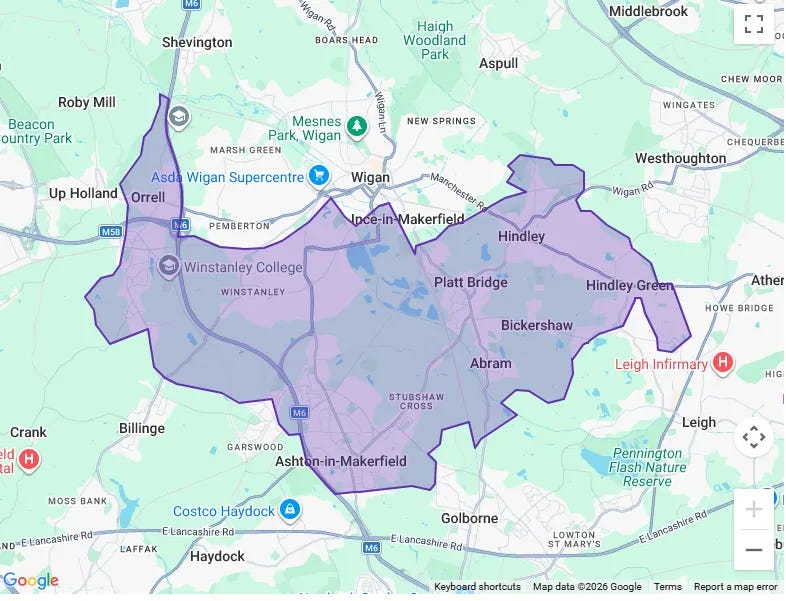
I had not intended to write this piece. The Restore Britain candidacy in Makerfield has already generated more heat than light, and I am conscious that adding my voice risks stoking a fire that serves nobody on the right of British politics well. But the question follows me: at public meetings, in messages from Reform activists, from journalists I respect. So let me try to address it soberly, and with as much charity as the facts permit.
First, let me be clear about what I have not said and what I have not asked. I have never called on Restore to stand aside. That call has come from others in Reform or Reform adjacent, and I understand the impulse, even if I think it was always for the birds. We made those arguments once ourselves, on the receiving end, from the Conservatives. “Stand aside, you’ll split the vote, you’ll let the other lot in.” The argument has a certain mechanical logic and absolutely no political force whatsoever, because it presupposes that Restore’s voters are Reform’s voters by right. They are not. Every party, including Restore Britain, has the absolute democratic right to stand candidates wherever and whenever it chooses. That is not in question. What I have asked, quietly and I hope reasonably, is that Restore’s people consider the consequences of their actions: for Makerfield, for the country, and for the larger cause of genuinely reforming a British state that has drifted badly from its democratic foundations.
Some people I respect, honest pollsters and journalists whose judgement I have no reason to doubt, have told me personally that for the first time they have encountered actual Restore voters in the field. I accept that. I note, though, that Restore have never previously stood anywhere: not in Great Yarmouth, not anywhere. The first time a party stands, it always finds voters it could not have found before, because those voters had nowhere to go. The existence of Restore voters is not itself evidence of Restore’s political weight or its wisdom in standing here.
Now let me address what is actually at stake in Makerfield, because I think the Restore argument systematically understates it.
Andy Burnham is not simply a Labour candidate in a by-election. The polling momentum behind him is real and significant. The strong probability, as I read the intelligence available, is that he wins the Labour leadership on the back of a convincing, or unconvincing, victory here, and that once he holds that leadership he will seek his own mandate. He is a man of considerable political talent and considerable political ambition, and his programme is the most comprehensively left-wing prospectus Labour has offered since the 1980s. Look at what he is actually proposing. Public ownership on a scale not seen since nationalisation was doctrine. A fundamental reorientation of economic policy away from markets and toward state direction. Identity politics entrenched in public institutions rather than rolled back, rejoin the European Union. And running beneath all of it, the one mechanism that would change the rules of the game permanently: proportional representation.
This last point deserves the most careful attention, because it is the one that Restore’s leadership appears either not to understand or to have decided not to care about. Burnham’s PR agenda is not a procedural reform. It is a constitutional lock. Its effect, whether intended or not ( and I think it entirely intended), would be to make it structurally impossible for any single party holding a coherent reform programme to win an outright majority and implement it. Under PR, Reform, Restore, and every other party on the right of British politics would be permanently condemned to coalition negotiations with parties that would exact the price of their participation in diluted policy, delayed delivery, and endless procedural friction. The green shoots of democratic and constitutional renewal that so many of us have spent years working toward would have fast-setting socialist cement poured over them before they could take hold. A Burnham victory here matters. A Burnham premiership, arriving on a wave of post-by-election momentum, with PR as his constitutional project, matters enormously.
Against this, the Restore case. Their central claim, repeated by Rupert Lowe and echoed across social media by his more vigorous supporters, is that all Labour figures are the same, Reform and the Tories are essentially equivalent: that it is all the uniparty, that there is nothing meaningfully to choose between them. I have to say, with respect, that this is patently and provably untrue. Reform’s record in local government, its positions on immigration, on Net Zero, on civil liberties, on the democratic accountability of public institutions, represents a genuine and substantive break from the political consensus of the last thirty years. One may argue about pace, emphasis, internal culture. One may not, in good conscience, argue that there is no difference between a party committed to rolling back mass illegal immigration and a party that presided over it.
There is also the matter of Restore’s own conduct in this campaign. Their candidate has declined press interviews. This is, to put it mildly, unusual for a party claiming democratic seriousness. Rupert Lowe’s conversation with David Shipley of the Spectator was, I am afraid, an extraordinary piece of work: a stream of consciousness that raised more questions than it answered about the coherence of Restore’s political project. Their canvassing data and polling claims from Makerfield have been, to put it generously, creative. All parties and activists paint the rosiest picture they can of their internal numbers: that is human nature and electoral common sense. But the Restore claims have moved beyond optimism into a realm that respected journalists like Harry Horton of ITV, who spoke to me about this only yesterday, simply cannot reconcile with what they are finding on the ground. Luke Tryl’s focus group data tells the same story.
Then there is the question of Restore’s behaviour in council chambers where they already hold seats. In Kent, Restore councillors have voted or abstained in ways that have allowed Labour, the Conservatives, and the Liberal Democrats to block measures aimed at addressing illegal immigration. Whatever Restore’s rhetoric, their record in the one place where record can be examined is, to say the least, difficult to square with their positioning as a more robust alternative to Reform.
I have also noticed, and I am not the only one, a pattern in social media responses to Reform figures that bears examination. The “weak sauce” accusations, the “controlled opposition” characterisation, the coordinated pile-ons whenever a Reform politician says or does anything at all, these have a quality that feels less like organic political disagreement and more like an operation. The similarity to the pro-Scottish independence bot networks, whose infrastructure became considerably less active after events at a certain data centre in Tehran, is not something I can prove. But I think it is a question worth asking: who actually benefits from Restore doing well and dividing the right of centre vote in Makerfield? It is not the country. It is not the ordinary men and women who are fed up with their treatment at the hands of a political class that has held them in contempt for a generation. The people who benefit are the people who need that vote divided.
And then there is Rupert Lowe himself. I have known Rupert for years. I have, on balance, liked him. I also know his record, and I think it deserves honest scrutiny. He is a man who has on against Tories at a moment claiming that he himself and others had been offered peerages (though not Farage himself) if Farage did so, who pulled his own Brexit Party nomination in Dudley on the day of the 2019 election. Behaviour that was in mentioned by Alex Phillips this week,
”Now, back in 2019, when we were MEPs and Boris called the election, Lowe collaborated on a list with the Tories called 'Men And Measures' with Dougie Smith. It was a list promising peerages, knighthoods and positions to Brexit Party candidates to stand down. My colleague Robert Rowland blew the whistle to me”.
Lowe undermined then party leader, Richard Tice at the Reform conference in 2023 by calling from the stage for Farage’s return just as Tice was about to deliver his own leader’s speech. At Birmingham in 2024 he spoke for ten minutes beyond his allocated time, announced policies entirely outside his brief, including the abolition of the Barnett Formula, which caused predictable chaos in Scotland and Wales and handed the press a field day, and when asked why he had behaved that way, he told me directly: “I don’t care, I am right.”
How a person treats staff tells you much about their character.
All these things were forgiven.
Then there was the personal attack in a wildly trailed article in the Daily Mail. There were the bullying allegations in his office, though resolutely denied. Eventually, Farage’s patience, which is more considerable than is commonly understood, ran out.
How Lowe was subsequently dealt with was not Reform’s finest hour. Reporting him to the police was, in my judgement, excessive and a mistake. That does not change the underlying picture.
I am entertained to recall seeing Lowe in earnest private conversation with Robert Jenrick, long before Jenrick eventually joined Reform, at a rather agreeable London club (not the only time they met). The Conservatives have given Lowe one of their positions on a Commons select committee, a courtesy that parliamentary rules have denied to Reform. The contours of this are not difficult to read. Restore Britain are not fielding a candidate in the by-election in Aberdeen, where the Tories have a chance of winning, whereas they are in Makerfield…
I write all of this not in anger. Genuinely. There are people drawn to Restore for reasons I understand perfectly well, frustration with Reform’s internal structures, impatience, the human desire to find a cleaner vessel for legitimate political hope, the purity paradox. I have no quarrel with them, and I mean that. But the question of Makerfield is not a question about internal party politics. It is a question about what happens to this country if Andy Burnham wins, builds on it, and pours his programme of managed decline and permanent constitutional lock into the foundations of the next decade or more, at which point what will there be left of this land we all love so much?
Personally I believe that people are not dumb, and when in the voting booth they will see the real choice in front of them and will vote accordingly, maybe I am too sanguine.
The stakes are too high for the luxury of the splinter.
Currently, according to polls, Makerfield is a two horse race which, come polling day, few can have failed to notice. That does encourage tactical voting so what is said to pollsters and what happens in the privacy of the polling booth can be quite different.
We saw this in the recent Westminster council election. Lib Dem and Greens were said to be doing well, Reform stood in all wards and were optimist based on doorstep responses, yet on the day only Labour and Conservative councillors were elected. Not a single independent, Green, Lib Dem or Reform.
It was obviously a two horse race and most voters so wanted Labour gone that they voted to ensure that happened. It did. The Conservatives won 32 seats to 22.
The problem with Makerfield will be over how may voters still want Labour v those who want to see the back of them. I hope Reform does not get sidetracked into attacking Restore. Don't big them up with attention/ Just ignore them and focus solely on discrediting shape shifting Burnham. He and Labour are the target. Full broadside please.
A very measured piece, Gawain, thank you for this.
Thank you also for pointing out that up to Makerfield, no Restore candidate has stood anywhere, nor (obviously) been elected anywhere.
Restore have consistently misrepresented the Great Yarmouth result - one has to wonder why anyone would need TWO political Parties.
The argument about ‘standing down’ and ‘splitting the vote’ are circular - like yourself, I believe every elector should vote for whomsoever he wishes.
And that applies to Makerfield.
Again, like yourself, I sincerely hope everyone will carefully consider the importance of this by-election; I believe it to be probably the single most important and consequential of my lifetime.