
The Purity Club
How the Establishment Parties Are Choosing Posture Over People

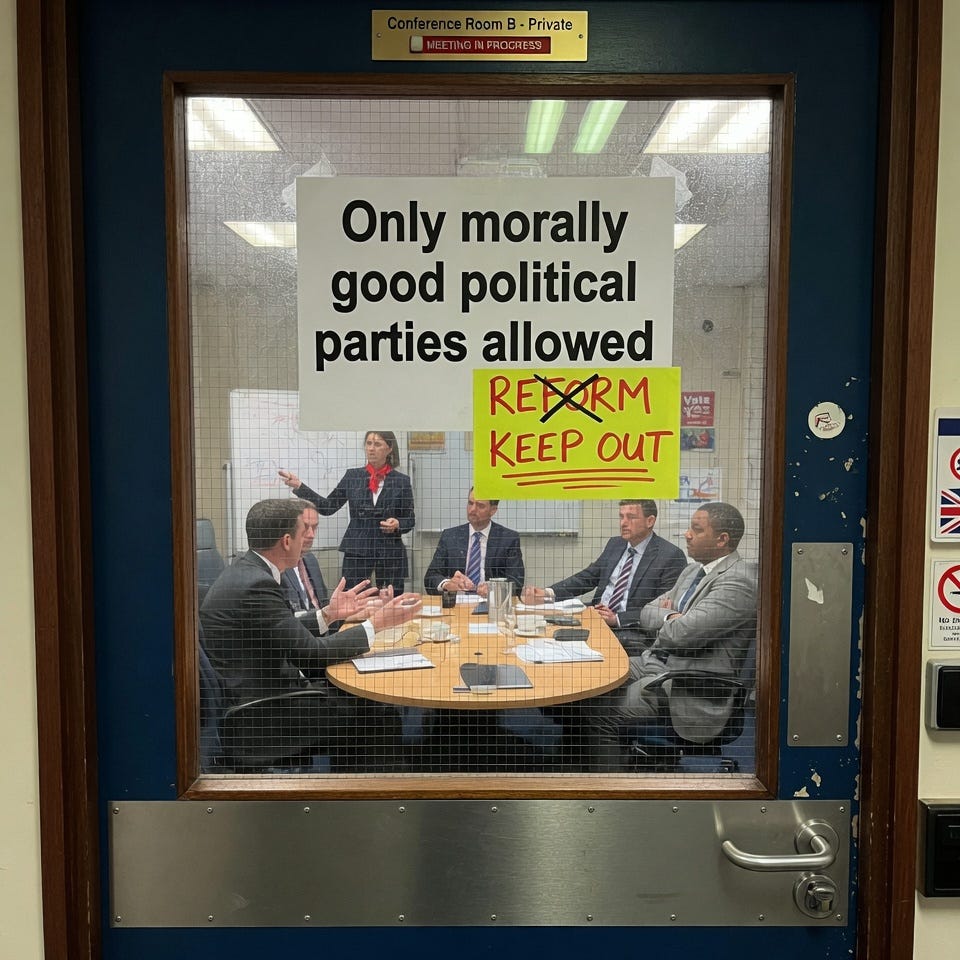
There is a game the legacy parties play, and they are playing it with renewed fervour this week. As the dust settles on the most seismic set of local elections in a generation, and as Holyrood and the Senedd adjust to a dramatically new political landscape, leaders from Labour, the Conservatives, the Liberal Democrats, the Greens and Plaid Cymru are all competing to say, with maximum righteousness, the same four words: we will not cooperate.
The target of this collective shunning, or what the continentals would call a cordon sanitaire, is Reform UK, which has just taken control of fourteen councils across England, sent seventeen MSPs to Holyrood and returned a substantial number of Senedd members to Cardiff Bay. Somewhere north of 745,000 Scots voted for Reform. Across England, the party won between 31 and 27% (depending on your source) of the vote, more than any other party. In places like Sunderland and Gateshead, Labour heartlands held since their creation, Reform swept in not on a protest wave but on a tide of settled, deliberate conviction.
None of that, apparently, entitles Reform’s elected representatives to be treated as legitimate participants in the democratic process.
The most emblematic example of this syndrome comes from Scotland, where First Minister John Swinney has made the performative exclusion of Reform central to his post-election positioning. Before a vote had even been counted, Swinney declared that he would cooperate with Reform in “no way, shape or form“, limiting himself, he graciously acknowledged, to answering parliamentary questions as required by the ministerial code, since to do otherwise “would breach“ it.
After the results, when Swinney announced he would call a meeting of opposition leaders to discuss cross-party cooperation in what is now a minority SNP government, he was quite deliberate about who would not receive an invitation. Malcolm Offord, whose seventeen-strong Reform group is the joint second-largest party in the Scottish Parliament, will not be at the table. The 745,419 Scots who cast their votes across the constituency and list ballots for Reform will, in Swinney’s telling, simply have to wait outside. The First Minister’s justification was that many Scots would feel “unsettled“ by a party he characterised as hostile to minority groups, a formulation that, conveniently, removes any obligation to engage with arguments rather than caricatures, whilst simultaneously trying to dimiss us as English
Offord’s response was measured and, I think, correct: “This is a disgraceful attempt by John Swinney and the SNP to silence the hundreds of thousands of people across Scotland who are backing Reform UK. The First Minister talks endlessly about democracy and inclusion, yet the moment voters support a party that challenges the failing political consensus at Holyrood, he wants to pretend they don’t exist. It is arrogant, petty and deeply undemocratic.“
His newly elected Deputy Leader, Thomas Kerr put it with a touch more Glasgow colour: “It speaks volumes that not a single vote had been counted yet John Swinney has come out saying he refuses to engage and cooperate with another democratically elected party.”
In Cardiff, the pattern repeats. Rhun ap Iorwerth, leader of Plaid Cymru and likely First Minister of Wales, has ruled out working with Reform in any configuration, coalition, confidence-and-supply, or anything else, not in the aftermath of the election but well in advance of it, as a badge of political honour. “We wouldn’t work with Reform,” he said flatly earlier this year. “That really is not on the cards.“ When pressed on whether this applied to every type of arrangement, he replied: “Yes. I cannot see a way at all.“
The irony here is considerable. Plaid has spent the last decade-and-a-half propping up a Welsh Labour government that has, by any objective measure, overseen the destruction of the Welsh NHS and left Welsh communities behind. The arrangement that delivered that result was apparently sustainable. The prospect of talking to Reform about, say, infrastructure investment or fixing local services apparently represents a bridge too far.
The Senedd, expanded from sixty to ninety-six members, now contains parties from across the spectrum. Government requires negotiation. To announce in advance that one set of elected representatives will be excluded from all of it is not democratic principle. It is democratic theatre.
South and East of the borders, the same refrain echoes. The Liberal Democrats have spent considerable energy positioning themselves as, in the words of one party source, “the strongest Reform-fighting machine in British politics.” Ed Davey’s conference speech named Nigel Farage thirty times. The strategic logic, such as it is, is to define the Lib Dems entirely in opposition to Reform, which is, as critics within the party quietly acknowledge, not much of an identity.
The Conservatives, for their part, are in a more delicate position. Kemi Badenoch has described herself as “the right,“ and watched helplessly as her party’s county council strongholds, Essex, Suffolk, Hampshire, were swept away by Reform. The Conservatives lost forty-one seats in Essex alone while Reform gained fifty-three. In Havering, they were wiped out entirely, losing all twenty-three of the seats they were defending. Yet even as their councillors fall and their MPs defect, the party line holds: no formal cooperation with Reform. One suspects this owes less to principle than to terror, the terror of confirming what many now believe, that Reform has become the natural party of the English right.
The Greens, fresh from their own sucessful night, winning control of Norwich, taking significant seats across the country, have been similarly emphatic. The Green party’s self-understanding as a progressive force makes any truck with Reform unthinkable by definition, regardless of whether there might be local issues, planning disputes, or community concerns on which the two sides’ residents are broadly aligned, as former Deputy Leader, Rupert Read discovered the other day when I debated him on Times Radio, only to find significant areas of agreement on the importance of local communities.
Labour, in freefall, having lost control of thirty-eight councils and seen 1,496 councillors swept from office, has perhaps the most to gain from constructive cross-party working, and the least political capital to afford the luxury of blanket exclusion. Yet the culture holds. The old Bain Principle, Labour’s long-standing refusal to vote with the SNP on anything, has its spiritual heir in the current attitude to Reform. The party would sooner lose more ground than be seen to cooperate.
Set against all this moral posturing stands a rather inconvenient fact: sixty-one councils in England are now under no overall control. Twenty-two more crossed into that state on Thursday. Every one of those councils must, somehow, get its business done, budgets set, social care delivered, planning decided, bins collected. The Senedd and Holyrood are both minority situations requiring informal or formal agreements to function. Governing is not optional. The electorate has not produced neat majorities. They have produced something complicated, and they have elected Reform councillors and MSPs and Senedd members to be part of that complexity.
Reform’s record in its first year of council control, limited though that is, has been pragmatic. Where we have councillors and now council leaders, they have got on with the job. They have worked with whoever was available to work with, in the interest of the people who elected them, rather than retreating into an ideological corner and congratulating themselves on their purity. That is what one might hope, elected representatives are supposed to do.
This refusal to work with Reform is stupid in two distinct ways, and it is worth being precise about both.
Tactically, it is an own goal of spectacular proportions and the particular entertainment of it is that the old parties cannot see what they are doing to themselves. They could read this and reflect, but their blindness is tungsten wrapped.
Multi-party governance is messy. Coalitions require compromise. Budgets get cut in places nobody wanted them cut. Planning decisions disappoint somebody. Social care costs more than the figures suggested and delivers less than the promises implied. Minority administrations make deals that satisfy nobody entirely. This is not a failure of Reform, or of the Greens, or of anyone in particular, it is the inevitable friction of governing in a fragmented political landscape, and it leaves marks on everyone involved.
Everyone, that is, except the party that was refused a seat at the table.
By excluding Reform from cross-party working, the legacy parties are constructing, with their own hands, a perfect inoculation against the one thing that genuinely tests a political movement: the responsibility of governance. Where the old parties are forced to stitch together arrangements, Labour and the Lib Dems in Newcastle, Plaid and assorted others in Cardiff, the SNP navigating Holyrood on minority life support, they will make the compromises, absorb the blame, and own the failures. Reform, declared untouchable by the very people who should be drawing us into shared accountability, will watch from the sidelines with clean hands and a growing mandate.
Every pothole that goes unfilled because a no-overall-control council couldn’t agree a budget will be blamed on the parties that controlled the negotiation. Every social care crisis, every planning row, every broken promise of local government — Reform will inherit none of it, because we were never permitted to be part of it. They have inoculated us against their own disease, and they have done so voluntarily, in the name of partisan principle, and looking glass virtue.
Our reputation remains entirely unsullied. They keep us clean while loudly claiming the opposite.
Strategically, it is worse still, and the lesson comes not only from the old parties but from a rather closer quarter.
The general public are not stupid. When they see elected representatives, chosen by hundreds of thousands of their fellow citizens, refused a seat at the table by people who then lecture them about democracy, they draw the obvious conclusion. This is not principle. This is petulance. It is the closed-shop politics of people who cannot win the argument and so have decided not to have it. And it plays, with grinding inevitability, into everything Reform has been saying since we were founded: that there is an establishment consensus, that it protects itself, and that it is more interested in its own perpetuation than in the welfare of the people it nominally serves.
But let us be honest about where that pathology has spread. In Kent and in Norfolk, Rupert Lowe’s Restore Britain, the vehicle constructed by and for a man whose grievances with Nigel Farage are, whatever their merits, essentially personal, stood candidates against Reform in the very seats where the old parties are weakest and the need for a coherent insurgent presence is strongest. In Great Yarmouth, The local Restore franchise took enough seats to deny Reform a majority on Norfolk County Council, handing itself the balance of power. Whatever the original provocation, the practical consequence was to split a vote that was trying to say something, and to do so in service of a factional quarrel that the electorate neither caused nor endorsed. In this, if in nothing else, Lowe’s people have caught the same infection as the legacy parties: the preference for ideological positioning over electoral duty, the choice of the gesture over the outcome.
The people of Great Yarmouth voted for change. They will be watching what their new Restoresque councillors actually do in the chamber, whether they vote on local issues as those issues deserve, whether they find common ground with Reform where the residents’ interests demand it, whether they treat the council chamber as a place to govern or merely another stage for a quarrel imported from Westminster. One hopes, genuinely hopes, that freed from the hothouse of national politics and confronted with the unglamorous specifics of bin routes and planning applications and social care budgets, the Great Yarmouth First councillors will discover what every good local councillor eventually discovers: that the ward doesn’t much care about the feud. It cares about the road.
That would be a lesson worth learning. It is one the Labour leaders of Gateshead and Sunderland, the SNP in Holyrood, and Plaid in Cardiff appear entirely unwilling to absorb. Every time they choose purity over people, they confirm the diagnosis. And when the next elections come, and they are coming, the public will remember who governed and who merely performed.
Every time John Swinney excludes Malcolm Offord from a cross-party meeting while governing Scotland as a minority first minister, he does our work for us. Every time Rhun ap Iorwerth preens himself on his refusal to talk to Reform while his country’s health service crumbles, he illustrates exactly the political failure that made Reform necessary. Every time Ed Davey defines his party purely by what it opposes rather than what it stands for, he demonstrates the hollowness of the political centre.
The local elections of 2026 were, by any measure, a historic moment. The question is not whether Reform is now part of the political landscape. That is settled. The question is whether the other parties have the wisdom to govern in a fragmented world, and whether, when the next elections come, the public will remember who chose purity over people.
They will.
Another great article. My Sunday morning pick me up.
Perhaps if the Reform councillors keep in touch with all voters on the results of each vote - keeping it factual - then this lack of accountability will be exposed.