
Silence for Some
Speculation for Others

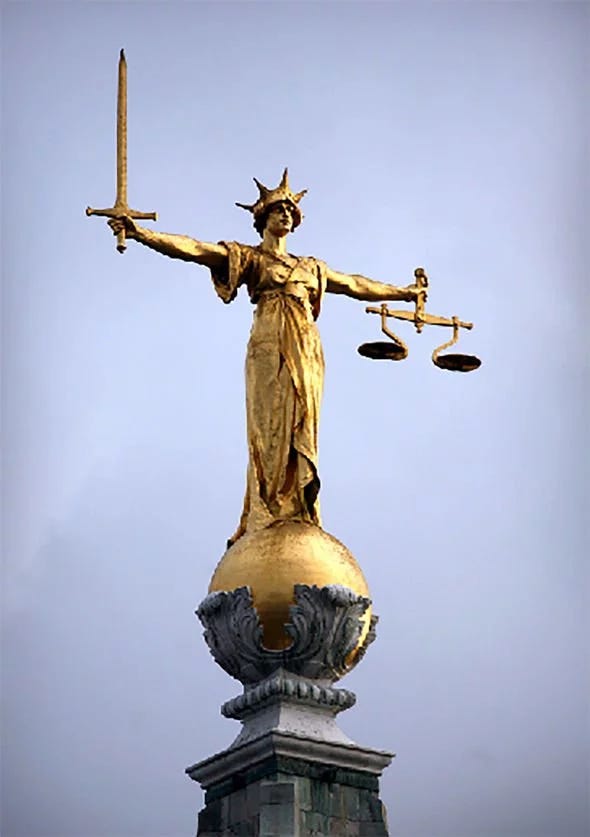
A note on what follows. A man, Kerry, has been charged with the murder of Ann Widdecombe. He was remanded at Westminster Magistrates’ Court on 21 July and committed to the Central Criminal Court for trial on 9 October 2026. Proceedings are active within the meaning of the Contempt of Court Act 1981, and nothing in this piece asserts or implies his guilt, speculates on the evidence against him, or characterises his motive. Those questions belong to a jury and to nobody else. This piece is about the people who talk around a criminal investigation, in uniform and out of it, and about which of them get told to be quiet.
Ann Widdecombe was murdered in her kitchen on Dartmoor. She was my friend, and the friend of many of us, and the grief does not need rehearsing here. What needs rehearsing is the fortnight of official communication that followed, because that fortnight ran in parallel, almost to the day, with another counter-terrorism investigation eight counties away, into a suspected far-right plot against an Islamic gathering in Suffolk. Two live cases, the same weeks, the same law of contempt, the same duty of restraint. So I have set the two timelines down together, interleaved, date by date, because nothing I could write would hammer home the double standard half so hard as the calendar does on its own. Watch who speculates in each case, watch who is scolded for it, and watch what the evidence eventually did to each set of confident early words.
First, the caution that is legitimate, because honesty requires it be stated up front. Once a suspect is in custody, warning the public against speculation is orthodox contempt-of-court practice, old as the 1981 Act and sharpened by hard experience since. Theodora Dallas went to prison in 2012 for researching a defendant online and telling her fellow jurors. In Karakaya a conviction was quashed outright after internet printouts turned up in the jury room. The first trial of Angela Wrightson’s killers collapsed at Teesside, and the Court of Appeal had to ring-fence the retrial. Christopher Jefferies was monstered as a suspect in the Joanna Yeates case before being cleared, and the Attorney General prosecuted newspapers for contempt. A family liaison officer who asks the bereaved and the public to mind what they post is doing what any competent force would have done in 1985. That caution deserves respect, and this piece intends to honour it to the letter, in both cases.
Now the calendar. Dartmoor and Suffolk, side by side.
Wednesday 8 July. Dartmoor. Ann is attacked at her home at Haytor at around 12.30pm, on the police’s own later account, in the gap between two scheduled interviews.
Thursday 9 July. Dartmoor. She is found at about 11.40am. Suffolk. The UK Ijtima opens at Shrubland Hall near Ipswich, a gathering that will draw some ten thousand people over four days.
Friday 10 July. Dartmoor. Devon and Cornwall Police launch a murder inquiry. The force lets it be known that officers are seeking a white male suspect. Note that detail. The suspect’s presumed race is volunteered to the public within a day, unbidden, while every other line of inquiry is guarded like the Crown Jewels.
Saturday 11 July. Dartmoor. A 26-year-old man is arrested, then released, the force stating he is “no longer part of the investigation”. A second man, 28, is arrested. Nigel Farage lays a wreath near Ann’s home and says that from what he can make out this was premeditated, that a car came onto her drive between two diary appointments, and that he does not believe for a moment it was a burglary gone wrong.
Sunday 12 July. Dartmoor. The response to Farage arrives on schedule. The Times carries the accusation that he is using Ann’s death as political propaganda. Dan Hodges declares it staggering that a senior political leader would speculate on a live investigation. The Mail on Sunday produces a highly placed source, unnamed, reporting that family members, also unnamed, do not want her death hijacked for political purposes. A chorus demanding silence, in the name of the integrity of the case. Suffolk. On police advice the Ijtima closes early, a major incident is declared, and the first arrests are made over a suspected extreme right-wing threat to the event.
Monday 13 July. Suffolk. The arrest count reaches twelve, held under section 41 of the Terrorism Act. Before a single charge has been laid, the Home Secretary announces that the police response to a credible threat has undoubtedly saved lives. Read that again. A Cabinet minister, on live proceedings, tells the country not merely that a plot existed but what its consequence would have been, its body count implied, its character settled, while the suspects sit uncharged in custody.
The Sunday scolds of the Widdecombe case say nothing. Not one column, not one thread, not one highly placed source deplores speculation on a live counter-terrorism investigation. Dartmoor. On the very same day, the Home Secretary makes a public statement on Ann’s case, Counter Terrorism Policing takes over the investigation, and the man in custody is rearrested on suspicion of the commission, preparation or instigation of acts of terrorism, Assistant Commissioner Laurence Taylor stating that new information and evidence means CT Policing now leads. The man accused of gobbing off turns out to have been closer to the mark than the official line he was gobbing off against.
Tuesday 14 July. Suffolk. Four of the twelve are quietly released on bail pending further inquiries. No ministerial statement accompanies them out of the station.
Thursday 16 July. Suffolk. A thirteenth man is arrested. Searches continue across homes and vehicles, more than thirty-five digital devices seized.
Saturday 18 July. Suffolk. Seven men are released from custody without charge. Another is bailed with strict conditions. Commander Helen Flanagan of Counter Terrorism Policing London states that extensive inquiries have found, at this time, no evidence to support charging anyone with any offence linked to the alleged threat. One man, 42, is charged over extendable batons and a stun gun found in the searches, which the police themselves state they do not believe is connected to the alleged plot. So ends, for now, the plot that had undoubtedly saved lives by Monday lunchtime. I make no assertion about what those thirteen people did or did not intend. That is precisely the point. Neither, on the evidence so far gathered, do the police. The assertion was made for them, from the despatch box of public opinion, and no retraction has carried a fraction of the weight of the original announcement.
Monday 20 and Tuesday 21 July. Dartmoor. The suspect is charged with murder, appears at Westminster Magistrates’ Court, and is committed to the Old Bailey for 9 October.
Set out like that, the fortnight speaks for itself. On the Saturday, a politician stood by a hedge in Devon and drew a mild inference from a car, a drive and a diary, and was accused in a national newspaper of propaganda. By the Monday, a Secretary of State had characterised an entire uncharged terror plot down to its hypothetical death toll, and the same commentariat found nothing worth saying. One of these interventions was substantially vindicated within forty-eight hours by the police’s own escalation. The other was substantially deflated within five days by the police’s own admission that there was no evidence to charge anyone with anything connected to it. Guess which speaker is still being cited as the menace to justice.
Two behaviours sit side by side in that calendar. One is the old, orthodox, honourable caution of a force protecting a future trial. The other is something newer, a machinery of impression management that volunteers a suspect description when it suits, narrates an uncharged plot when it suits, and treats the public’s attempts to reason about what is in front of them as a disorder to be managed. Malinformation, the category invented in 2017 and embedded in the Government Communication Service’s RESIST toolkit, is truthful information deemed harmful, and its whole logic is that the problem with the public is not that they believe false things but that they notice true ones at inconvenient moments. (I will be digging deeper into this concept in due course).
And if the Suffolk comparison were not enough, the same week supplied a third case. On 18 July, US Marshals arrested Andrew and Tristan Tate in Miami on a UK extradition request, the CPS having charged them with fifty-nine offences between them, including rape, trafficking and offences relating to indecent images of a child, arising from complaints in the East of England between 2010 and 2017. They deny every allegation and are contesting extradition. Those are active English proceedings, headed, if extradition succeeds, for an English jury, exactly the situation in which the contempt regime bites hardest.
What has followed? American prosecutors’ detention filings, setting out the allegations in graphic and specific detail, reproduced across every front page and news channel in Britain. A police statement issued at the point of arrest declaring that there is no place for male violence against women and girls in our society, which, whatever its merits as a sentiment, is an editorial attached to an unproven charge sheet. Commentary flowing freely, wall to wall, about the character, ideology and presumed conduct of two men awaiting trial. Some of it may yet cause real difficulty in an English courtroom, and if it does, the victims, if victims there prove to be, will pay the price of it.
I have no brief whatever for the Tates, whose public output I regard as poison. But I have been unable to find the voices who declared Farage’s four sentences at Haytor a threat to justice raising so much as an eyebrow at a week of pre-trial saturation coverage of defendants in an active English case. Apparently the fair trial rights of the man accused of killing my friend are so delicate that a wreath-side remark endangers them, while the fair trial rights of the Tates can survive the publication of the prosecution’s case in extenso before a jury has been sworn.
So let us name the principle actually in operation, because it is not sub judice. Sub judice is a rule, and rules apply evenly or they are not rules. The principle in operation is that speculation is dangerous when it is inconvenient and wholesome when it is useful. Ann’s case, where the early inferences pointed somewhere the official mind preferred not to look, attracted the full apparatus of hush. Suffolk, where the inference flattered the approved threat picture, was narrated by a Secretary of State before the evidence was in, and un-narrated by nobody when the evidence declined to appear. The Tates, indefensible in the court of public opinion, may be tried there nightly without a murmur. That is not the law of contempt. That is malinformation doctrine wearing the law of contempt as a disguise, truth and silence alike deployed by reference to harm as the managers define it.
And because the standard must cut all ways or it is worthless, let it cut our way too. Some from my side have asked publicly whether the Suffolk arrests were a diversion from Ann’s murder, they have done what Mahmood did, characterising a live investigation ahead of the evidence, and we should not have done it either. My side does not get an exemption from the discipline I am demanding of theirs. That is what demanding a rule means.
What Ann is owed now is a trial conducted so cleanly that its verdict, whatever it proves to be, stands beyond challenge, and what the country is owed is the truth about why she died, established by evidence in open court and not by anyone’s press office, on any side, in advance. The counterterrorism command has shown the way to talk while that work is done, which is to say almost nothing, and to say it plainly. We are establishing the motivation. Five words, no comfort, no theory. It is the only statement in this whole sorry fortnight that cannot be quoted against anyone in October, and every communicator in every force, and every Secretary of State, should have it pinned above the desk.
Notes
Devon and Cornwall Police statements, 10–11 July 2026; the force stated its belief that the attack took place at around 12.30pm on Wednesday 8 July. See AFP report, 12 July 2026.
Westminster Magistrates’ Court hearing, 21 July 2026; the defendant was remanded in custody and committed to the Central Criminal Court for 9 October 2026.
CNN, 11 July 2026, reporting the arrest and release of a 26-year-old who “is no longer part of the investigation.”
Statement of ACC Matt Longman, Devon and Cornwall Police, 10 July 2026, as reported by AFP, op. cit. n. 1.
Devon and Cornwall Police statement, 11 July 2026.
Government Communication Service, RESIST 2: Counter-Disinformation Toolkit, November 2021, discussed in “Malinformation, or the Inconvenient Truth,” this publication, July 2026.
Al Jazeera, 14 July 2026, reporting the rearrest and the statement of AC Laurence Taylor, head of Counter Terrorism Policing.
Statement of the Home Secretary, 13 July 2026, reported ibid.
Charging announcement and prosecution statements, 20–21 July 2026.
Devon and Cornwall Police statement, 11 July 2026, op. cit. n. 5.
AFP, op. cit. n. 1, reporting the force’s earlier statement that officers had been searching for a white male suspect.
Denis Kavanagh KC (@Jebadoo2), thread on X, July 2026.
R v F and D (reporting restrictions), Court of Appeal, 2016, arising from the collapsed first trial of the killers of Angela Wrightson at Teesside Crown Court and the restrictions imposed on the Leeds retrial; Contempt of Court Act 1981, ss. 1–2.
“Nigel Farage accused of using Ann Widdecombe’s death as propaganda”, The Times, 12 July 2026, quoting Harvey Proctor; Dan Hodges (@DPJHodges), X, 11 July 2026; The Mail on Sunday, 12 July 2026.
Counter Terrorism Policing / Metropolitan Police statements, 13–19 July 2026, on the investigation into the suspected threat to the UK Ijtima event, Shrubland Hall, Suffolk, 9–12 July 2026, including the arrest of twelve people on 12–13 July, a thirteenth man on 16 July, the release on bail of four people on 14 July, the release of seven men without charge on 18 July, and the statement of Commander Helen Flanagan, CTP London, that “at this time we have found no evidence to support anyone being charged with any offences linked to the alleged threat.” https://news.met.police.uk/news/update-investigation-into-suspected-threat-to-event-in-suffolk-511423
Statement of the Home Secretary, Shabana Mahmood, 13 July 2026, that the police response to a “credible threat” had “undoubtedly saved lives”, as reported by ITV News Anglia, 13 July 2026. https://www.itv.com/news/anglia/2026-07-13/twelve-arrested-over-right-wing-terror-threat-to-islamic-event
Metropolitan Police statement, 18–19 July 2026, on the charging of a 42-year-old man with possession of offensive weapons and a stun gun, offences the force stated were not believed to be connected to the alleged threat. Reported by PA Media, 19 July 2026.
Crown Prosecution Service and Bedfordshire Police statements, 18–20 July 2026, on the arrest of Andrew and Tristan Tate in Miami by the US Marshals Service on a UK extradition request, 59 charges in total including rape, trafficking for sexual exploitation, assault occasioning actual bodily harm and offences relating to indecent images of a child, arising from alleged offences between 2010 and 2017; statement of ACC Karena Thomas, Bedfordshire Police. See Time, 20 July 2026; CNN, 18 and 21 July 2026. The brothers deny all charges and are contesting extradition.
US Department of Justice detention memoranda filed in extradition proceedings, SD Florida, reported by ABC News, 22 July 2026, and CNN, 21 July 2026.
Another exceptionally well written piece, Gawain, and some really focussed points.
The narrative behind the facts you illustrate is beyond disturbing; that the Establishment of my country should behave in as hypocritical, egregious and virtually criminal behaviour as you describe is outrageous.
Is almost literally incredible.
Is beyond the best works of Goebbels.
What to do?
I believe the intent is clear, overall it is to destroy Reform and Nigel Farage - all else is the UniParty - so our response must simply be not to be cowed, not to believe a word of it, and to do our damnedest to expose them and to hold them to account.
As you do so well.
Oh - and we must vote Reform UK
The Suffolk 'case' (can we even call it that?) is another example of the demand for 'far right terrorism' being vastly greater than the supply.