
Freeborn No More?
The Crime and Policing Bill and the Slow Death of English Liberty

I want to be careful here. Because I am aware that what I am about to write will sound, to comfortable metropolitan ears, like the raving of a man who has lost his grip on proportion. So let me say it plainly first, and then defend it.
The Crime and Policing Bill, currently completing its passage through Parliament, represents the most comprehensive assault on the traditional liberties of the freeborn Englishman since the Stuart kings. It is more dangerous than those royal provocations, because it comes dressed in the language of safety, of community, of respect, and because it is only part of a wider pattern that, when you step back and see it whole, should stop the blood.
Let me begin with a man most people have never heard of. Giles Udy is one of Britain’s finest historians of Soviet Communism. His book Labour and the Gulag is a work of meticulous, uncomfortable scholarship, tracing the seduction of the British left by the Bolshevik experiment. He has spent twenty years studying what it actually looks like when a state decides that its ideological certainty entitles it to total control over those who do not share its worldview.
Udy has recently made a statement that I suspect cost him some effort to compose. He is not a man given to hyperbole. But writing about Soviet repression, he finds it, as he puts it, “really hard to bring a similar accusation against the Labour government and Keir Starmer.” Hard, but he reaches it nonetheless. “What Labour and the old Soviet regime do have in common,“ he concludes, “is the arrogant belief that they alone hold the moral high ground and that this entitles them to total control over all those who do not share their worldview.“
He is careful to note we have no Gulag, no death penalty. So am I. But his observation about the tools of control is what should make us stop. Legislation, and courts co-opted to apply it. The policing of dissent, hate crime orders, arrests, the long-term seizure of electronic appliances to intimidate those against whom no charges are ever brought. Twelve thousand arrests annually for social media posts. The framing of dissent as fascism, a habit, Udy notes, with deep roots in the Labour movement’s Stalinist period, when ‘fascist‘ became the approved term for anyone who inconveniently noticed what was happening in Moscow. Orwell’s thought crime, he argues, has become a reality. It is 2026, and he cannot believe what he is seeing. Nor can I.
The Crime and Policing Bill is long, sprawling, and, by design or effect, very difficult to scrutinise whole. That is itself a constitutional objection. The English common law tradition works by accretion and specificity: a particular abuse, a particular remedy, debated on its own terms. Omnibus legislation of this kind, bundling knife crime with facial recognition databases, Respect Orders with protest restrictions, warrantless home entry with youth diversion, is a mechanism for slipping the controversial through in the shadow of the popular. Nobody is against catching phone thieves. But buried in the same Bill is the permanent infrastructure of a surveillance state.
Consider the DVLA clause. Clause 95 gives the Secretary of State powers to make regulations granting police, the National Crime Agency, and the IOPC access to driving licence information, including photographs, for general law enforcement purposes. There are fifty-five million driving licences in Britain. The government says it has no intention of using those photographs for facial recognition. But the previous Conservative policing minister said explicitly that exactly this was the purpose of an identical clause in an earlier Bill. The Lords voted down an amendment to prevent it by 123 votes to 40. In plain English: every photograph taken at the DVLA for the purpose of road traffic administration could, by ministerial regulation and without further parliamentary approval, become part of the largest biometric police database ever created in this country. You would be placed in a digital police line-up without your knowledge, without your consent, and without having committed any offence.
This is not fantasy. Live facial recognition vans were deployed at the Notting Hill Carnival in August 2025, and at the Unite the Kingdom rally last weeknd, the Metropolitan Polioce’s Deputy Commissioner, James Harman boasted to the media that the Met would be “taking a zero-tolerance approach supported by specialist resources including live facial recognition, helicopters, drones, dog units, police horses, armoured vehicles and dedicated investigative teams”. The infrastructure is already operational. The Bill regularises and massively expands it.
Now add what was announced in this week’s King’s Speech, the Digital Access to Services Bill, bringing forward a national digital ID scheme. It is presented, with characteristic smoothness, as a convenience: easier access to public services, a simpler way to prove who you are. The government calls it voluntary. They would. They called it mandatory until three million people signed a petition against it and even their own backbenchers were using the words “dystopian disaster.”
Let us be precise about what has actually happened. Last September, Keir Starmer announced a compulsory digital ID, the “BritCard”, presented initially as a tool to combat illegal immigration and as a mandatory requirement to prove the right to work. Public support collapsed from net +35% to -14% in weeks. The petition gathered 2.9 million signatures, making it one of the largest in parliamentary history. Labour backbencher Rebecca Long Bailey spoke of “building an infrastructure that can follow us, link our most sensitive information and expand state control over all our lives.” In January 2026, the government backed down, stripped out the compulsory requirement, and renamed the policy. Now it returns in the King’s Speech as the Digital Access to Services Bill, wearing the word “voluntary” like a fig leaf. And we will be told it is our patriotic duty to carry one.
But infrastructure is never truly voluntary. Once built, it expands to fill the available space. Once the GOV.UK app becomes the standard gateway to state services, benefits, NHS appointments, driving licences, passport renewals, not having one ceases to be a choice and becomes a penalty. And once that database exists, and once the DVLA facial recognition power sits on the statute book, and once live facial recognition vans are parked outside protests, and once the cumulative disruption clause allows police to decide who may assemble and where, then you have, by degrees and by stealth, created something that a former resident of East Germany would recognise on sight.
The honest version of this policy would say: we are building a single state database, keyed to your face, through which your access to services, your movement, and your right to protest can be monitored and, if necessary, controlled. The dishonest version says: here is a convenient app that will make renewing your driving licence much easier. We are being offered the second version. We should read it as the first.
The Respect Order is the centrepiece of the Bill: civil restriction with criminal consequences. It does not require a criminal standard of proof. It requires only that someone satisfies a court, on the balance of probabilities, that you have engaged in conduct “likely to cause harassment, alarm or distress.“ Not that you have. That you might. The Bill explicitly permits orders based on the possibility of future anti-social behaviour, the clause says “threatens to engage.” You can be restricted before you have done anything at all.
Under such an order, you can be banned from posting on social media, attending a protest, speaking in a public place, or entering certain areas, all without ever being charged with a crime. And if you breach the order, that is a crime. You can be arrested and imprisoned for up to two years.
This is pre-crime policing. The definition of the underlying behaviour, conduct “likely to cause” distress, is so elastic that being too loud, too opinionated, too persistent in one’s views could, in the hands of a motivated applicant and a receptive court, satisfy it. Housing providers can apply for these orders. Local authorities can apply. As the civil liberties lawyers at StopWatch have noted in their parliamentary submission, conditions attached to such orders are frequently impossible to comply with, creating a situation where breach is almost inevitable; and breach carries a prison sentence for conduct that was never, in itself, a crime.
You don’t need to break the law to be criminalised in Britain. You just need to annoy the wrong person.
Here we reach the gravest concern, and the least discussed. The Respect Order mechanism is designed precisely to bypass the institution that has been the Englishman’s ultimate protection against state overreach for eight centuries: the jury.
When charged with a criminal offence, the English subject has the right, on indictable matters, to be tried by twelve of his peers. They are not instruments of the state. They cannot be directed to convict. And throughout our history they have, on occasion, simply refused to do so when they judged a law unjust or its application oppressive: what lawyers call jury equity, and what the rest of us might call common sense breaking through. It was juries that repeatedly acquitted John Lilburne when the state sought his destruction. Lord Devlin, one of the twentieth century’s great jurists, described jury trial as “an insurance that the criminal law will conform to the ordinary man’s idea of what is fair and just.”
The Respect Order guts that protection entirely. The civil stage, where the order is made, carries no jury. The criminal stage, where punishment is imposed for breach, concerns not the underlying behaviour but the fact of violation of the court’s instruction. The jury never gets to consider whether your original conduct deserved restriction in the first place. The question twelve peers might have answered, is this person a genuine menace, or merely an inconvenience to authority, is never put to them.
This matters beyond the Respect Order, because this government is simultaneously attacking the jury from another direction. In December 2025, Lord Chancellor David Lammy announced reforms that will remove jury trial from a category of offences that will, in practice, cover many acts of civil disobedience and protest, replacing the jury with summary proceedings before magistrates, or new “swift courts“ of a single judge. Lammy justified this by citing Martin Luther King’s civil rights marches. The irony is almost too much: the civil rights movement worked precisely because juries sometimes refused to apply unjust laws. What Lammy proposes makes that impossible.
Taken together, Respect Orders bypassing juries on the way in and Lammy’s reforms removing juries from protest cases on the way through, we are watching the systematic dismantling of the people’s check on state power. And it is happening so quietly, across so many different legislative vehicles, that most of the country hasn’t noticed.
The Bill’s “cumulative disruption“ test allows police to ban or restrict a demonstration on the grounds that other protests have recently been held in the same area, whether or not organised by the same people. A Pro Palestinian rally in central London one week could become the legal basis for banning a farmers’ march the next.
Liberty challenged an almost identical provision under the last government and won in the courts. The current government appealed, lost, and is now legislating the same restriction back in, in stronger form. A government that repeats, in harsher form, a measure its own courts declared unlawful is one that regards the rule of law as an obstacle.
Clause 86 strips protesters of the one practical protection against the facial recognition vans now deployed at public gatherings. You may protest. But you must be identifiable. And your face may be checked against fifty-five million driving licence photographs, or, once the Digital Access to Services Bill becomes the standard gateway to state services, against the government’s own biometric app database.
This is where Udy’s historical frame becomes genuinely illuminating. The Soviet apparatus of control did not operate through a single dramatic act of tyranny. It operated through the steady accumulation of mechanisms, each defensible on its own terms, each capable of being turned at discretion against whomever the authorities chose to target. The danger of each measure was not its stated purpose. It was what it made possible.
The Crime and Policing Bill is not the Gulag. But it equips the British state with: a biometric database of fifty-five million faces available for facial recognition by ministerial regulation; a national digital ID infrastructure presented as convenient but designed to be inescapable; civil orders that restrict speech and assembly without criminal conviction; protest rules that can be used to ban demonstrations on grounds of cumulative inconvenience; warrantless powers of home entry; and systematically weakened access to jury trial. Each piece has a plausible justification. Together, they transform the relationship between citizen and state in ways that, if they were happening somewhere else, we would have no difficulty naming.
A future government must commit, as a matter of constitutional priority, to repealing these provisions wholesale. The DVLA facial recognition powers must be explicitly prohibited by primary legislation. The cumulative disruption clause must be repealed entirely. The Respect Order must be reconstructed so that criminal consequences require criminal-standard proof before a jury. Lammy’s swift court reforms must be reversed. Warrantless home searches must return to judicial authorisation. And the Digital Access to Services Bill must be amended to prohibit, permanently and by primary legislation, any connection between the digital ID infrastructure and law enforcement databases; not by ministerial assurance, which is worthless, but by law with criminal penalties for circumvention. INdeed, the Digital ID should be scrapped in its entirety.
This is not a partisan matter. The Conservative record on protest restriction is not clean; the groundwork was laid before 2024. Any future government of any colour that inherits these powers will use them. Power accumulated by one administration is available to all subsequent ones. That is precisely why it must not be accumulated.
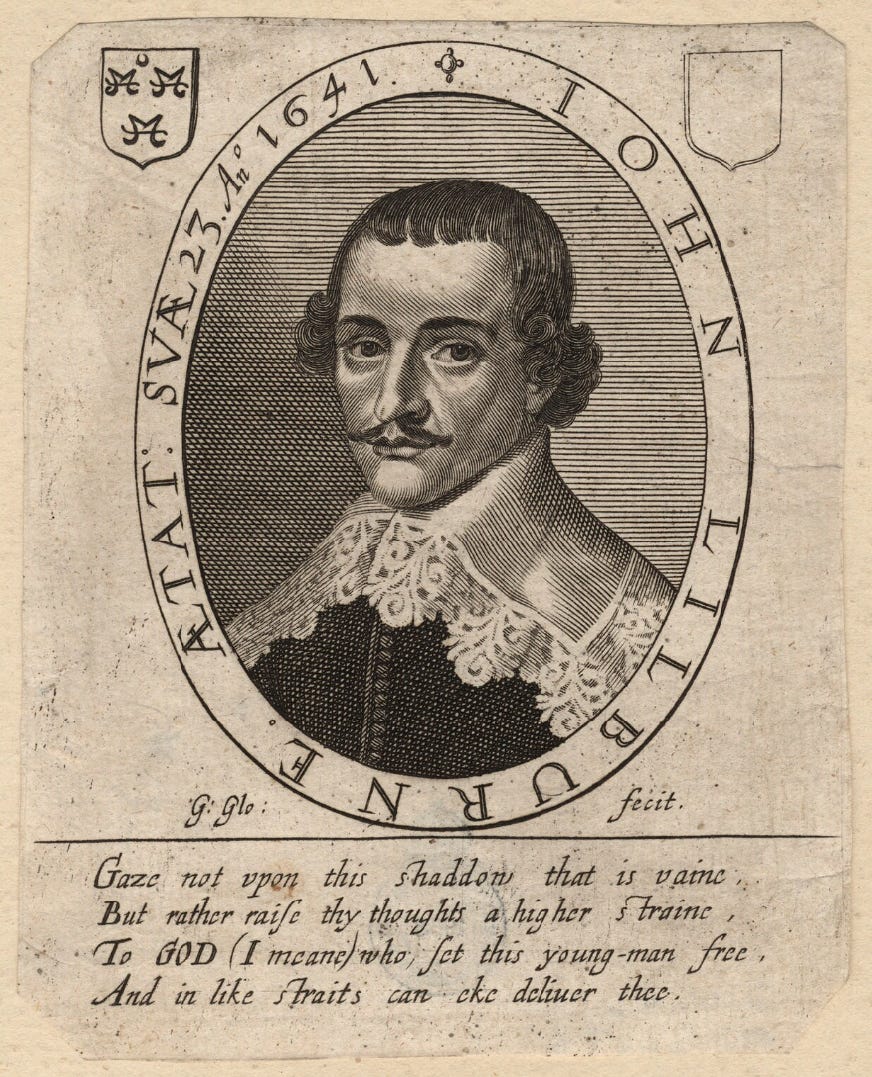
There is a figure from the English tradition who is exactly the right patron for this moment. His name was John Lilburne, Freeborn John, a seventeenth-century agitator who spent much of his life in the Tower of London, flogged, tried for his life, and consistently acquitted by juries who refused to convict him. He coined the phrase “freeborn rights“: rights belonging to every English (and by extension UK citizen) not by government grant but by birth, which no Parliament, no court, no king may take away. He defied, in succession, king, Parliament, and Protectorate. He once described himself as “an honest true-bred, freeborn Englishman that never in his life loved a tyrant nor feared an oppressor.”
Note what that means. Not a conservative. Not a radical. Not a party man. A man who challenged arbitrary power wherever it arose, whatever colours it flew. When Parliament itself became tyrannical, as it did, it was Lilburne who said so, and took the consequences.
It is in that spirit that I am calling for the formation of the Lilburne Society.
Not a political party. Not a pressure group with a narrow agenda. Not a vehicle for any one cause, candidate, or faction. The Lilburne Society would exist for one purpose: the defence and restoration of the ancient liberties of the freeborn people of these islands, through articles, speeches and actions. The right to assembly and free speech. The sanctity of the home against warrantless intrusion. The right to be tried by one’s peers on criminal charges rather than condemned by civil mechanism and administrative discretion. The right to exist, to move, and to dissent without one’s face being checked against a government database. It would monitor, publish, campaign, and litigate. It would be, unapologetically and in the tradition of Lilburne himself, a permanent irritant to any power that mistakes temporary electoral authority for a licence to remake the relationship between the state and those it governs.
There are more people of this disposition than the current Parliament imagines. Farmers who drove their tractors to Westminster. Mothers who objected to what was being taught their children. Writers who discovered that certain thoughts were not to be expressed. People of left and right, religious and secular, who share the instinct, the very English instinct, that something has gone badly wrong, and that it is their right and their duty to say so.
Who is with me?
It is 2026. The Respect Order awaits Royal Assent. Lammy is reforming the jury. Your photograph is one ministerial regulation away from a police facial recognition database. The King’s Speech has just launched a digital ID that the government calls voluntary and intends to make inescapable. You cannot attend a protest if the cumulative disruption test applies. Your home can be entered without a warrant on the basis of a phone app.
Freeborn John would not have stood for it. Nor should we.
The Lilburne Society is open to all who believe that the liberties of the freeborn people of England were not given by the state and cannot legitimately be taken by it.
To register your interest: gawain@gmail.com
Just about the scariest essay I’ve read, ever. Shout it loud and good luck.
To answer your question, I'm with you.
"Of all tyrannies, a tyranny sincerely exercised for the good of its victims may be the most oppressive. It would be better to live under robber barons than under omnipotent moral busybodies. The robber baron's cruelty may sometimes sleep, his cupidity may at some point be satiated; but those who torment us for our own good will torment us without end for they do so with the approval of their own conscience. They may be more likely to go to Heaven yet at the same time likelier to make a Hell of earth. This very kindness stings with intolerable insult. To be "cured" against one's will and cured of states which we may not regard as disease is to be put on a level of those who have not yet reached the age of reason or those who never will; to be classed with infants, imbeciles, and domestic animals.”
― C.S. Lewis, God in the Dock: Essays on Theology