
Beyond the M25
How Reform is Forcing Britain’s Media to Look Up and Out

For as long as most political journalists can remember, the unspoken compact of British media has been simple: politics happens inside the M25, and everything beyond it is scenery. Local government, that vast, unglamorous engine of bin collections, planning applications, and social care budgets, was safely beneath notice. The councillors of Lincolnshire and Lancashire might as well have been governing a different planet for all the interest Fleet Street showed.
Reform UK has broken that compact. Decisively, and I suspect permanently.
Over the past year, we have watched something genuinely novel: the mainstream media, print and broadcast alike, has been dragged blinking into the town halls of England. Ten councils now governed by Reform, and a good many more where we sit as a credible opposition, have received a level of journalistic attention previously reserved for Westminster ministerial reshuffles. The BBC has despatched correspondents to Lincolnshire. National newspapers like FT seem to have a Reform local government correspondent, and have run pieces on local procurement decisions. The Today programme has taken an interest in matters that, eighteen months ago, would never have made it past a junior producer’s slush pile.
One might be uncharitable and observe that much of this scrutiny has been less than friendly. The assumption embedded in many of these pieces is that Reform councils must, inevitably, be mismanaging something. Yet even hostile coverage is a form of acknowledgement. It says: this matters. These places matter. The people who elected these councils made a decision worth examining. That, in itself, is a kind of democratic progress.
It is a progress long overdue. And now, at last, Scotland and Wales are receiving the same service.
Ever since devolution, the London-based media has treated the devolved nations as an irrelevance to be managed rather than a story to be told. Coverage was rationed to horror shows, NHS waiting lists so catastrophic they demanded a response, disasters of sufficient magnitude to justify the flight north, and corruption scandals spectacular enough to override the metropolitan editor’s instinct to ignore Edinburgh and Cardiff entirely. Nicola Sturgeon ultimately fell, it should be remembered, not because Scottish journalists exposed her, but because the scale of the implosion became impossible to contain. Even then, the London papers took their time.
Scotland and Wales have, for a generation, been governed by establishments largely insulated from genuine scrutiny. In Wales, the nature of the one-party state has produced something close to a client media, outlets economically and institutionally entwined with the Labour administration in Cardiff Bay, disinclined to bite the hand that, directly or indirectly, feeds them. In Scotland, the SNP and Labour have long occupied essentially the same economic and territory, producing a political monoculture in which the press has found comfort rather than challenge. Dissent is managed. Awkward questions are deflected. The Overton window is kept firmly nailed shut.
These elections are different. I have never seen coverage of Scottish and Welsh voting in the London media to match what we are seeing now, not since Donald Dewar, who founded the whole devolution project and received, in death, a fraction of the column inches now being devoted to Malcolm Offord.
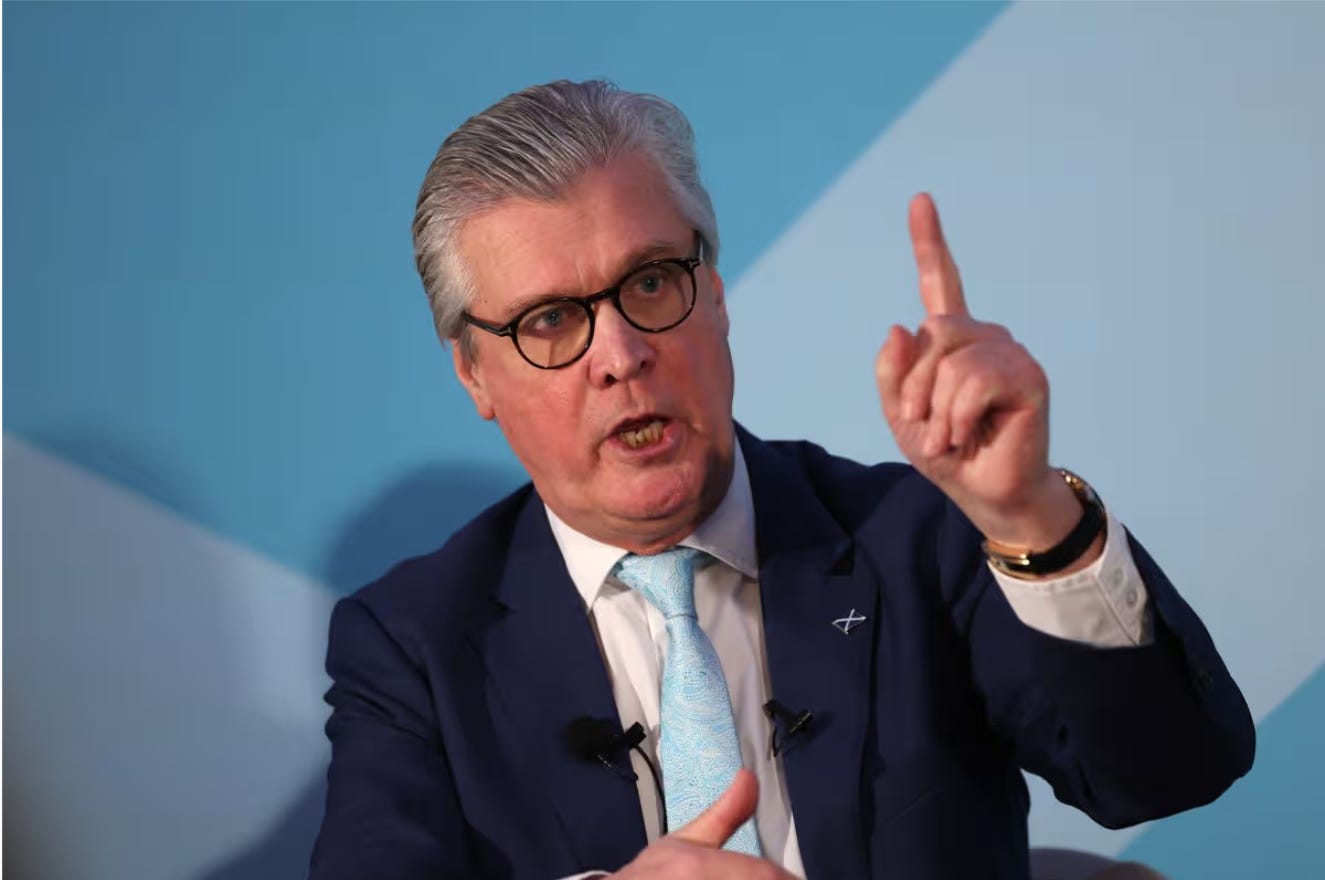
Reform UK’s Scottish leader, Offord deserves particular attention, because what he has done in Scotland is something quite extraordinary. He is a man who rose from a Greenock tenement, not as metaphor, not as political biography carefully burnished for effect, but as plain biographical fact, to build a successful life through enterprise, application, and the kind of unapologetic ambition that was once considered a Scottish virtue. He has had the audacity to say, in public, in Scotland, that success is something to be celebrated, that enterprise is to be encouraged, and that Scotland and the Scots are capable of rather more than the managed decline their political class has come to mistake for normality.
The response has been instructive. Every establishment party has attacked him. The Scottish media has furrowed its collective brow. The implicit accusation, that to celebrate success is somehow to insult those who have not yet achieved it, has been deployed with the reflexive fury of an ideology that has run out of arguments. And yet, and this is the thing worth watching carefully: the attacks have not landed as intended. Something has shifted.
For perhaps the first time in living memory, there is in Scotland an actual argument about what government is for. Not a debate about which party can best administer the existing settlement, not a squabble about the constitutional question, but a genuine, philosophically grounded argument about the relationship between the state and the individual, about ambition and community, about whether a society organised around the celebration of failure and the management of low expectations is, in fact, a society worth defending. Offord offers helping of fine roast Aberdeen Angus, everybody else the wateriest Cullun Skink.
Adam Smith, that great son of Kirkcaldy, would recognise the argument. He would be astonished it needed making in his own country in 2026. But I suspect he would be pleased that someone is finally making it, and making it without apology.
That is what Reform, at its best, does. It does not merely put candidates on ballots. It changes the terms of debate. It forces media that had quietly accepted the existing settlement as permanent to confront the possibility that it is not. It compels journalists who had stopped asking certain questions to start asking them again.
Scotland and Wales have been waiting a long time for that service. The waiting, it seems, is over.
Absolutely agree about Malcolm Offord. Such respect should be afforded him for putting himself into the ring when he could have stayed in his cushy position in the House of Lords. Money or not, that is a move that must have tremendous courage and patriotism, and it should be applauded.
Dan Brown has been equally impressive, albeit in a quieter, less extravert way. Both have a monumental task and it all starts this week - good luck to them and all Reform candidates.
It seems to me that other right of centre parties, eg Rupert Lowe’s Party, the name escapes me, must all join forces for the next election. They must think only of the future of our country and not of their various egos. Reform is just as guilty of this. Anyone whose voice is listened to/heard needs to get this message across loud and clear: the country comes first