
Token policy
Land Tokenisation and England’s New Land Use Framework

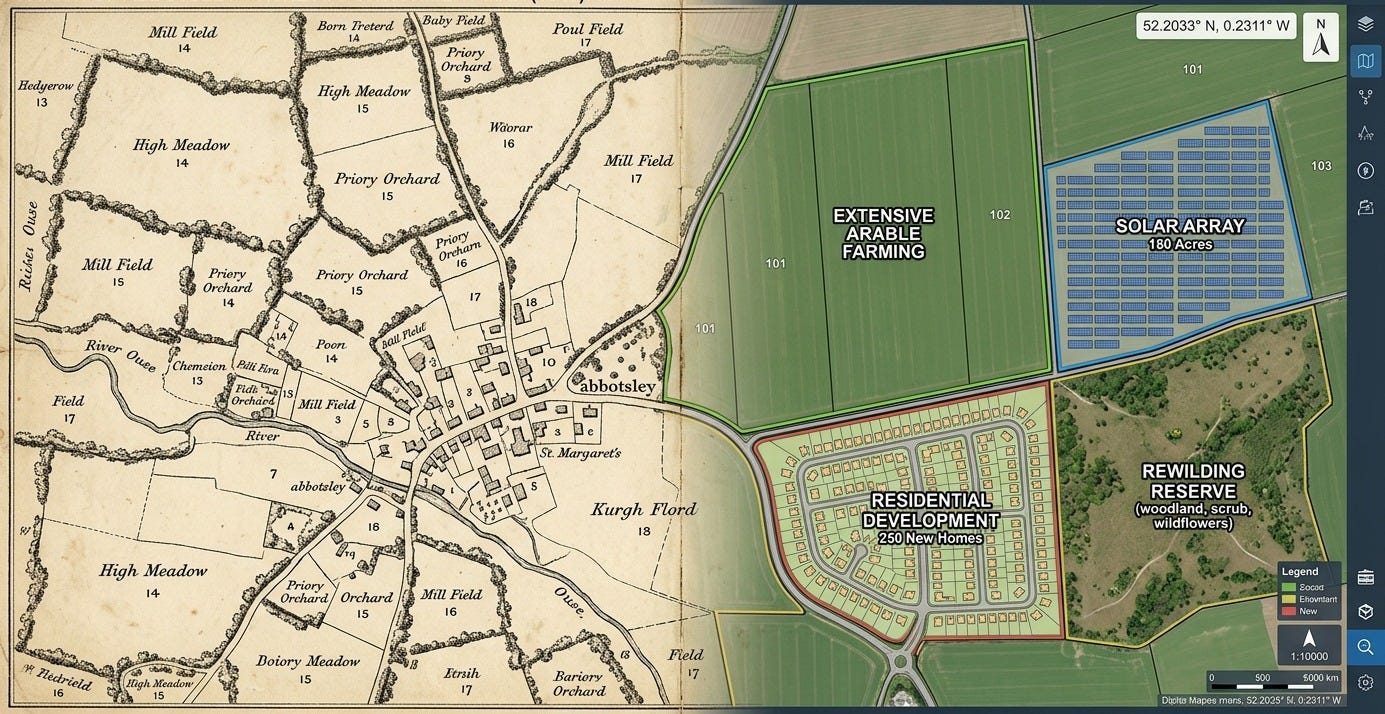
What is land? Is it the soil beneath our feet, the hedgerows that mark parish boundaries, the inheritance passed from father to son, the quiet guarantor of food on our tables and character in our countryside? Or has it become mere data, quantifiable, divisible, programmable, an asset to be fractionalised, traded on blockchain ledgers and optimised for whichever policy target or investor return demands priority this week?
England’s first Land Use Framework, published on 18 March 2026 by Environment Secretary Emma Reynolds, insists the answer is both. It promises a “multifunctional” future in which the same finite acres deliver food production, nature recovery, 1.5 million new homes, clean energy and climate resilience without “false choices”. Yet the document’s true innovation lies elsewhere: its relentless commitment to “making land digital”. By linking foundational datasets through the Government National Data Library, opening large parts of the Land Registry, publishing granular maps of public spending and creating interactive spatial tools, the Framework supplies the precise infrastructure required for land tokenisation to scale from experimental curiosity to national reality.
Land tokenisation, the conversion of real-world land rights into tradeable digital tokens on a blockchain, has moved from fringe NFT sales (a beachfront plot in Lymington tokenised in 2022) to serious policy adjacency. The Property (Digital Assets etc) Act 2025 has cleared the legal path for digital assets to be treated as property. HM Land Registry’s earlier proof-of-concept with ConsenSys demonstrated “Title Tokens” for fractional ownership. What the Framework provides is the missing high-resolution, verifiable, publicly accessible ledger: ownership, soil quality, flood risk, biodiversity value, development potential and proximity to grid connections for every acre.
This is not administrative tidying. It is the digital Domesday Book, cataloguing the realm not for a medieval king’s tax rolls but for the demands of Net Zero, international capital and a state that increasingly sees the countryside as a delivery vehicle for its own highly partisan targets.
Is the Framework optimised for tokenisation? Ministers avoid the word, yet the alignment is unmistakable. Its “multifunctional” vision, encouraging land to produce food and nature credits and solar leases, translates directly into layered, programmable tokens. A single field could issue separate bundles: one for agricultural yield rights, another for biodiversity net gain (BNG) units, a third for carbon sequestration payments or renewable energy leases. Smart contracts would automate dividends; secondary markets would enable global investors to trade slivers of England without ever attending a parish council meeting. Liquidity would explode. Transaction costs would collapse. The Framework’s spatial mapping and data interoperability create exactly the conditions fractional ownership requires.
The competing demands on England’s land have never been more acute. We have 32 million acres of finite surface (13m hectares). Food security demands productive arable and pasture; government policy insists domestic production must be maintained at current levels. Yet the Framework acknowledges that 7% of England, an area two-and-a-half times the size of Cornwall, must shift toward nature recovery, forests and renewable energy to meet 2030 and 2050 targets. Renewables alone are projected to require only 1 per cent, but the cumulative pressure is immense. Solar farms already cover about 55,000 acres, often on grade 3 farmland; the Framework praises their “multifunctionality” with sheep grazing beneath panels, yet critics note that intensive arable output is permanently displaced. Housing targets of 1.5 million homes by the end of this Parliament push development onto greenfield sites, even as the document pledges to protect the “best and most versatile” (BMV) land. Nature recovery, through rewilding, wetland creation and woodland expansion, competes directly with grazing and cropping. Flood resilience schemes and carbon sinks pull in yet another direction. The Framework insists these are “complementary”, but the arithmetic reveals trade-offs: every acre given to solar or BNG units is one acre less for wheat, beef or affordable rural housing.
These tensions are not theoretical. Upland farmers face pressure to surrender grazing rights for tree-planting credits. Lowland arable estates watch solar developers outbid them for leases. Urban-fringe villages brace for housing estates justified by the Framework’s spatial prioritisation. The document’s own evidence base concedes the scale of change required, yet offers little comfort to those whose livelihoods depend on traditional uses. Instead, it promotes “spatial targeting” of Environmental Land Management (ELM) payments and the Sustainable Farming Incentive (SFI) to steer land toward government-preferred outcomes.
In practice, tokenisation would operationalise this vision with ruthless efficiency. Take a 200-acre holding in Lincolnshire. Under the Framework’s digital regime, its boundaries, productivity scores, ecological designations, flood zones and grid connections are mapped and linkable in real time. The owner registers title on a blockchain-compatible platform tied to the updated Land Registry. Tokens are issued representing proportional ownership or use rights. An institutional investor in Singapore acquires 5 per cent for carbon credit upside; a pension fund takes 10 per cent for the embedded housing option value; a renewable developer purchases a long-term lease token for a solar array. Smart contracts distribute environmental payments automatically. The original farmer may retain day-to-day management, or simply exit with liquidity previously unimaginable. Transfers settle in seconds. Global capital flows in; local stewardship flows out.
The sectoral implications are stark. In agriculture, the winners are large estates, corporate farms and institutional capital able to monetise environmental payments without full divestment. Tokenisation offers liquidity and diversification, selling carbon or BNG tokens while retaining operational control. Family farms, however, become collateral damage. Fragmented ownership erodes the long-term stewardship that has defined English agriculture for centuries. Speculative capital chases the highest “nature score” or renewable yield, bidding up values on land with high Framework-designated potential while marginal holdings are abandoned. Food production risks becoming secondary to financial engineering.
The environmental sector appears superficially victorious. Tokenisation turbo-charges private finance into nature recovery. BNG units, wetland credits and woodland carbon become instantly tradeable commodities. Conservation NGOs and green funds gain scale. Yet genuine biodiversity often arises from active, knowledgeable management by graziers, gamekeepers and upland farmers, not passive rewilding dictated by distant metrics. If tokens reward the highest modelled “nature score” irrespective of local context, we risk a new enclosure: productive land withdrawn to satisfy spreadsheet targets, severing the intimate bond between people and place.
Housing gains apparent acceleration. Developers and build-to-rent funds can fractionalise optioned land, spreading risk and mobilising capital toward the 1.5 million homes target. Smaller investors access once-elite assets. Yet communities lose. Local planning influence evaporates when fractional owners, frequently offshore, hold no stake in the parish. Transparency becomes a double-edged sword: prime development sites are exposed to international capital flows, inflating prices and eroding affordability for those who actually live there.
In energy, the pattern repeats with precision. Renewable developers secure swift project finance and exit liquidity through tokenised solar or wind rights. The Framework’s spatial tools “steer” developments to optimal (often agricultural) locations. Traditional energy players and food-producing land lose ground. The collision between clean power and domestic food security is resolved digitally in favour of the former.
This is where the Framework’s policy prescriptions load the dice. Far from neutral, the document tilts incentives toward government-preferred outcomes. Spatial targeting of ELM and SFI payments rewards land that scores highly on biodiversity, carbon or renewable metrics. BNG requirements create mandatory demand for offset units, generating tradeable assets perfectly suited to tokenisation. The emphasis on “multifunctional” land use masks a hierarchy: nature and energy outcomes receive strategic spatial priority, while productive agriculture is protected only rhetorically for BMV land. Data tools empower institutional investors, who can analyse at national scale, far more than individual farmers negotiating with planners. Planning reforms referenced in the Framework accelerate consenting for housing and renewables while environmental schemes provide the financial bridge that makes tokenised green uses more attractive than traditional farming. The result is not organic market evolution but directed financialisation: capital is guided toward Net Zero and nature markets, while conventional rural economies are gradually starved of viability.
Beneath the spreadsheets and smart contracts lies the deeper subtext. This is an unnecessary Digital Domesday Book. William the Conqueror’s clerks catalogued every hide and plough-team to extract revenue and impose the new order after conquest. Today’s technocrats map every acre not for feudal tribute but for the imperatives of international capital, Net Zero ideology and a central state that views rural England as a policy canvas rather than a living society. The Framework inventories land not to celebrate its custodians but to reallocate it, toward solar arrays, carbon sinks and investor returns.
Who is land for? The question the Framework never honestly confronts. It is for the people who till it, nurture it and depend upon it. It is for the market towns sustained by farming, shooting and tourism. It is for future generations who deserve more than a ledger entry. Tokenisation, enabled by this digital architecture, risks completing the long enclosure: turning the common inheritance into liquid financial instruments, severing the bond between land, labour and locality.
Rural England has faced central diktat before. Reform-controlled councils in Kent, Derbyshire and elsewhere have already demonstrated resistance, scrapping net-zero targets, prioritising practical energy efficiency and protecting productive use. The rest of us must now decide whether to accept this new Domesday or reject it outright. The clerks have opened their book. The question is whether we will let them close it on the England we recognise.
FFS. Selling England by the Pound. Whatever happened to national debate? First I've heard of it. You asked 'Who is the land for?' It's our home, identity, heritage, sustenance. We come from it, we are formed by it, we return to it. It is US.
This has been in the making for at least two years , along with other tweaks to the planning laws that render the countryside the government’s own to destroy at will ,destroying food production industries and more job losses , and whilst this is Marxist policy the public have been blissfully unaware, yet there is another real threat , the government are allowing the sell off of our nation grid land to developers of renewable energy. Mad milliband is now disregarding all planning rules as they still offer some protection in the stampede to build ,build ,build , all national security rules scrapped . Any project landing on his desk simply has the planning rules removed if not scrutinised , how are Reform Uk going to fight back from this , the damage is being done now with every application submitted.