
The Flood Has Come
And The Tide Is Still Rising.

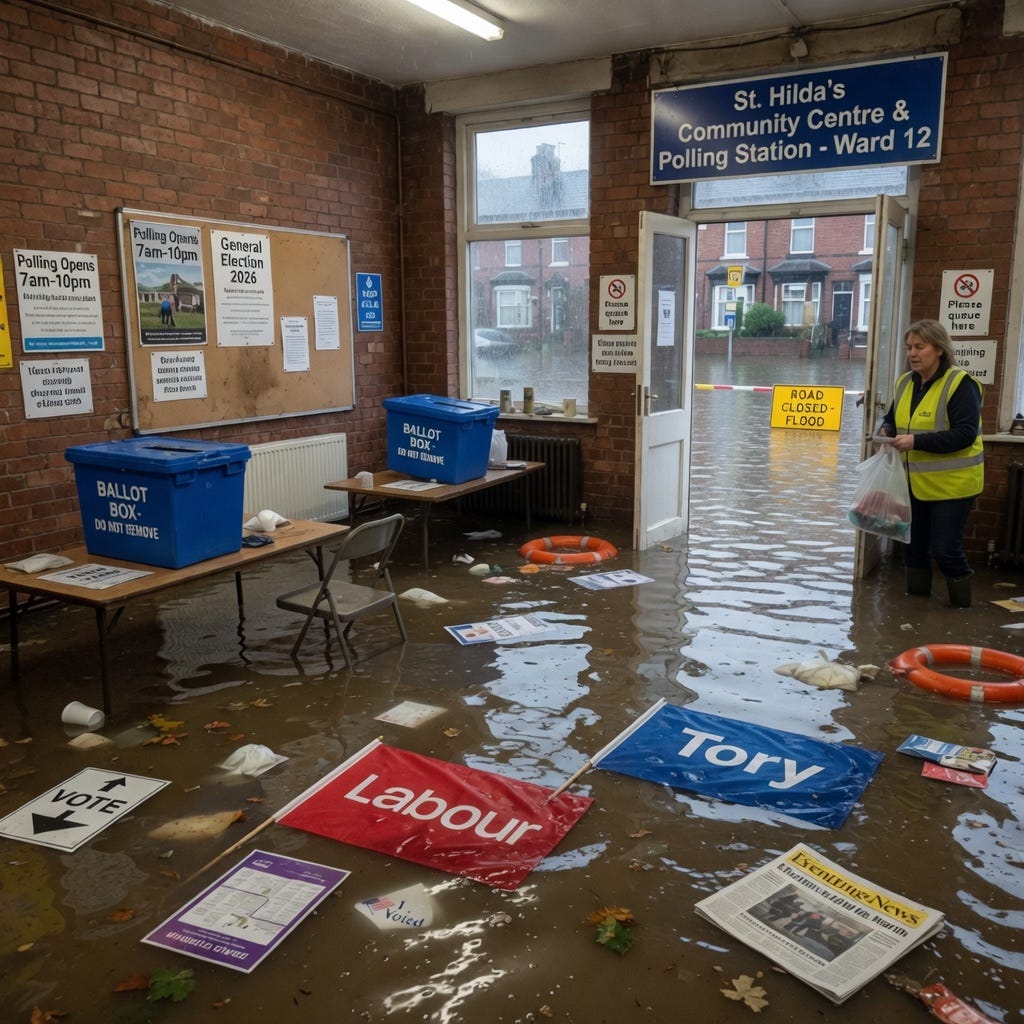
Count the councils. Thirteen in a single night. Walsall, Wakefield, Sunderland, St Helens, South Tyneside, Gateshead, Havering, Suffolk, Essex, Barnsley, Newcastle-under-Lyme, Thurrock, Calderdale. Add those taken in 2025, Kent, Durham, Lancashire, Doncaster, Derbyshire, Staffordshire, Lincolnshire, Nottinghamshire, North Northamptonshire, West Northamptonshire, and Nigel Farage’s party now controls more English councils than any party except Labour itself. A party that, before May 2025, had never controlled a single local authority in British political history.
The commentators will reach, as they always do, for the language of natural disaster. Earthquake. Tsunami. Tidal wave. The metaphors of geology and hydrology proliferate because the political class genuinely has no better vocabulary for what it is watching. But the geological metaphors are in one respect misleading: earthquakes end. What happened on Thursday was not a single seismic event. It was the second wave of a structural realignment, and the third is already scheduled for 2027.
The Councils That Fell
Begin with Wakefield, because Wakefield demands to be taken seriously as a symbol.
Labour has governed Wakefield Metropolitan Borough Council since its creation in 1974. Fifty-two years of unbroken control, through pit closures, deindustrialisation, regeneration schemes, and every twist of national politics from Thatcher to Blair to Corbyn to Starmer. The council had three leaders in that entire half-century. In 2022 at the Wakefield by-election Reform scrapped tpogether 1.6% of the vote. On Thursday, all 63 seats were up for election due to boundary changes — and Reform won 58 of them. Labour won one. The council leader, Denise Jeffery, who had served on the council since 1989 and led it since 2019, lost her seat in Castleford and Glasshoughton in the first wave of declarations. Reform’s branch chairman described the result as “beyond our wildest imaginations.” That the imaginations of Wakefield’s new councillors were insufficient for the scale of their own victory tells you something about the velocity of what is happening to English politics.
Barnsley follows the same template. Labour has governed Barnsley Metropolitan Borough Council since its creation in 1974. It has never been controlled by any other party. On Thursday, Reform won enough seats to form an outright majority. Labour lost control of Barnsley for the first time in the council’s existence, in a town whose identity, whose self-understanding, whose social fabric is so thoroughly interwoven with the Labour movement that the Miners’ Strike of 1984-85 is still spoken of in the present tense.
Sunderland. Labour has controlled Sunderland City Council since the authority was created in 1974. On Thursday, Reform won 58 of the 75 available seats. Labour won five. The council leader, Michael Mordey, lost his seat. His counterpart in Gateshead, Martin Gannon, lost his. In South Tyneside, the Labour leader Tracey Dixon lost hers. In Newcastle, Karen Kilgour lost hers. The Labour leaders of four consecutive North East councils were gone before the count was finished. In Gateshead, Labour. which had led the council for decades, slumped to third place behind the Liberal Democrats, finishing with twelve seats against Reform’s thirty-eight.
The eastern counties tell a different story, but no less damaging to the old order. Essex County Council has been under Conservative control since 2001. No other party has held an overall majority on the council since its creation in its current form in 1973. Reform won more than half of the 78 seats available, taking control from a Conservative administration that had seemed permanent. The Conservative leader, Kevin Bentley, lost his seat. In Suffolk, the same: Reform took a majority for the first time, ousting a Conservative administration. In Thurrock, in what was the unitary authority’s first all-out election, Reform won 45 of the 49 available seats. Labour was reduced to two members. The Conservatives to two.
Havering gives Reform its first London council, taken from a position of no overall control and turned into an outright majority, the outer eastern suburbs of the capital, historically Conservative, now Reform. Calderdale, in the Pennines, falls in an all-out election that wiped the Conservatives off the council entirely, reduced Labour to eight seats and handed Reform thirty-four. Newcastle-under-Lyme goes, ousting the Conservatives who had governed it under Simon Tagg since 2017, with Reform winning twenty-seven of the available seats for an outright majority. Walsall falls, with Reform securing forty of the sixty seats, a borough that had, in recent years, been governed by Conservative, Labour and no-overall-control administrations, none of which could have anticipated being replaced by this.
St Helens, that most Labour of Merseyside towns, is gone too.
The Sting The Thirds System Took Off — For Now
Labour’s strategists, casting around for consolation in the small hours of Friday morning, will have found it in the mathematics of the thirds system. English metropolitan boroughs elect by thirds, roughly one-third of seats come up for contest each year across a four-year cycle, with one fallow year. Councils under this system cannot be overturned in a single night. The existing Labour majority, built up across decades of elections in which Reform did not exist, provides a buffer that a single year’s results cannot dissolve.
Wigan is the clearest example, and the most instructive. Labour has controlled Wigan Metropolitan Borough Council since 1974. On Thursday night, in the tranche of seats contested, Reform won 24 of the 25 available seats. Labour lost all 22 of the seats it was defending in that cycle. And yet, because only a third of seats were up for election, Labour retains overall control of the council. The accumulated majority of decades holds, for now. After the election, the makeup stands at forty-two Labour, twenty-five Reform, and eight independents and others. Labour governs. But governing with twenty-five Reform councillors across the chamber from you, having just lost every single seat that came up for election, is not governance in any comfortable sense. It is a stay of execution.
In Tameside, where Labour had governed almost continuously since 1974, the party lost its overall majority for the first time in forty-seven years. Sixteen of the seventeen seats Labour was defending in Thursday’s tranche were taken by Reform. The council is now in no overall control. Labour remains the largest party, again, because the thirds system means two previous cycles of results still count, but it cannot govern with a majority. In Basildon, where a third of seats were contested, the result was similarly brutal for Labour, leaving the council in no overall control. In Dudley, the same pattern. In Tameside. Reform sweeping through every seat available to it, Labour surviving only because the accumulated weight of 2024 and 2023 results still sits in the ledger.
This is the particular cruelty of the thirds system as a mechanism of slow political torture. In the all-out councils, Wakefield, Barnsley, Sunderland, Gateshead, South Tyneside, Calderdale, Labour received the verdict at once. It was catastrophic, but it was clean. In the thirds councils, Wigan, Tameside, Basildon, Dudley, Hartlepool, Labour is condemned to watch the process unfold across three consecutive elections, knowing the conclusion in advance, unable to alter it, required to govern in the meantime as if authority still means something.
Here is the arithmetic that ought to be circulating around every Labour group room in every northern metropolitan borough next week. The seats that will come up in 2027 are the seats that were last contested in 2023. In 2023, Reform barely existed at a local level. Labour won those seats comfortably, in many cases running against token opposition. They will be defended in 2027 in a political environment where Reform is consistently polling above twenty-five per cent, where Labour is polling around twenty per cent, and where the results of 2025 and 2026 have demonstrated, without ambiguity, the direction of travel.
In Wigan, Reform won 24 of 25 available seats on Thursday. Next year, another third comes up. The sitting Labour councillors in those wards know that the seats they are defending were won in 2023, in a different world, against opponents who were not on the ballot paper. They know what Reform did in their borough on Thursday. They are not safe. They are staring down the barrel of an electoral gun, and the hammer is already cocked.
What The Map Now Tells Us
The shape of England’s local government this morning is one that neither of the governing parties of the previous century would recognise.
Reform controls councils across a geography that would have seemed fantastical three years ago: the coalfields of Yorkshire and the North East; the post-industrial heartlands of the West Midlands; the prosperous Essex commuter belt; a London borough; the county halls of ancient Conservative shires. The party that did not exist at a local level in 2022 is now the second largest force in English local government.
Labour has lost control of towns it has governed since the age of Harold Wilson. The Conservatives have lost county councils they held through Thatcher and Major and every convulsion since. Both parties are being eliminated simultaneously, Labour in the post-industrial north and midlands, Conservatives in the shires, by the same insurgency operating through different electoral vintages in different places.
The political establishment consoled itself after 2025 with explanations about protest votes and mid-term difficulty and the challenges of governing. Those explanations have not survived 2026. The protest vote does not win fifty-eight of seventy-five seats in Sunderland. The mid-term difficult does not take Wakefield from a party that held it for half a century. Something more fundamental has changed, and the thirds system means that those councils still holding on by accumulated history will find out, in twelve months, what Wakefield found out on Thursday.
The tide is still rising. The next wave is already dated.
We have witnessed a cry for help across the country. For change… not the sort previously offered by the uni parties, but a fundamental reset at every level. 🇬🇧🏴🏴🏴
A most puissant analysis, Gawain, thank you!