
The Cinderella Service
How Britain is Starving its Navy of the Means to Fight

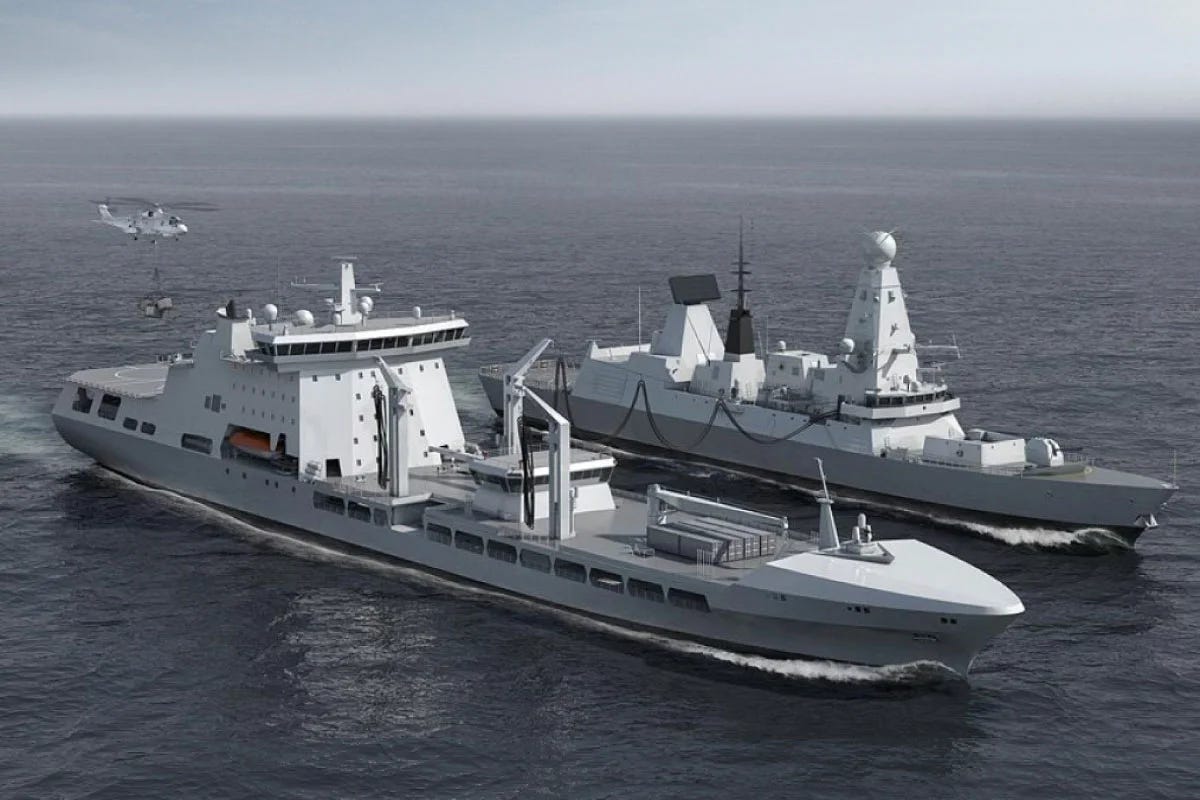
There is a message on my phone that I cannot stop thinking about. It came from a sailor in the Royal Fleet Auxiliary, and it is one of those communications that arrives half in anger and half in despair, the kind of message written at the end of a long watch, when exhaustion overcomes the natural reticence of people who do difficult things quietly and without complaint. The sailor writes of feeling laughed at by the Royal Navy, ignored by the Ministry of Defence, and invisible to the public they serve. It echoes the phrase, with a bitterness that clearly costs them something to admit, “the Cinderella service.” They are not wrong. And the consequences of that neglect extend far beyond hurt feelings.
The Duke of Marlborough, the greatest British commander who ever lived, understood something that our political class has spent three centuries struggling to absorb. His campaigns across the Low Countries and into the heart of Bavaria succeeded not because he had more soldiers than his enemies, often he did not, but because he could feed them, supply them, move them, and keep them in the field when other armies dissolved into starvation and mutiny. The logistical genius that sustained Blenheim and Ramillies was the foundation on which all the tactical brilliance rested. Strip away Marlborough’s supply lines and you strip away Marlborough. Napoleon, who understood almost everything about war, was right when he said that an army marches on its stomach. What he failed to apply consistently, and what eventually destroyed him, in Russia and elsewhere, was the corollary: logistics is not a support function. It is the precondition of everything.
If an army marches on its stomach, so much more does a navy sail on the same basis. A warship without fuel cannot move. A carrier group without solid stores, without the munitions, spare parts, and provisions that sustain sustained operations, is an enormous and expensive liability, capable of proceeding from port A to port B and little else. The Royal Fleet Auxiliary exists precisely to solve this problem. Its ships are the veins and arteries of British naval power; the fighting ships are the fist, but without the RFA pumping the blood, the fist cannot be raised.
Which makes what has happened to the RFA over the past two decades not merely a service management failure but a strategic catastrophe conducted in slow motion.
The numbers are damning enough stated baldly. In 2002, the RFA operated twenty vessels. Today it has nine ships in active service. The two Wave-class fleet tankers, relatively modern ships that could have served the fleet well into the 2030s, lie retired — not because they had reached the end of their useful lives, but because there were not enough sailors to crew them, and not enough money to pay sailors enough to stay. Fort Victoria, the RFA’s single solid stores ship, capable of simultaneously replenishing warships with fuel, munitions and victuals, has been in and out of readiness for years; when the Carrier Strike Group deployed to the Indo-Pacific in 2025, it did so escorted by a Norwegian stores vessel, Maud, because Fort Victoria could not get to sea. For the first time in history, a Royal Navy carrier group sailed on a global deployment without a British ship to keep it in dry stores. The Norwegians came to our rescue. We should be grateful. We should also be ashamed.
RFA Argus, the aviation training and casualty reception ship that doubled as a floating hospital, was declared unsafe to sail in 2025 and is now earmarked for scrapping. She was also the vessel earmarked for the littoral strike role — the replacement capability for the assault ships retired under previous defence reviews. Now she is gone too, and the replacement, the promised Multi-Role Support Ships, are not due until the 2030s. The gap is not a gap. It is an absence.
The proximate cause of all this is the crisis in recruitment and retention that is eating the RFA alive. RFA sailors are civilians employed by the Ministry of Defence, and their pay is set against a background of Treasury pay restraint and a department chronically unable to balance its equipment budget. Their salaries have fallen by more than thirty per cent in real terms over a decade. The commercial shipping sector, facing its own global shortage of qualified mariners, has responded to market pressure by raising wages. The RFA has not. The result is a steady haemorrhage of experienced people to better-paying employers — the very people whose skills, built up over years at sea, cannot be quickly replaced. Several vessels have been operating on minimum safe complements, running twenty to thirty per cent below full crew.
The pay dispute has now become an industrial crisis. Officers of Nautilus International voted to strike earlier this year in a ballot that achieved a 56 per cent turnout — remarkable given that many members were returning postal ballots from ships on active operations. Nearly nine in ten of those voting supported strike action. A 4.5 per cent pay offer was described by the unions as “wholly inadequate.” At the time of writing, RMT members have walked out again, with picket lines in Portland, Birkenhead and Falmouth. The MoD has repeatedly failed to produce an improved offer, or even to show up to negotiating meetings. The ministry, it seems, can find money for management consultants but not for the people doing the actual sailing.
The sailor who wrote to me used the phrase Cinderella service, and it captures something specific and corrosive. The Royal Navy, with its traditions, its ships named for battles and its very public presence, receives whatever institutional attention and public sympathy there is to go round. The RFA, which makes all of it possible, is invisible. Its sailors are not in uniform in the conventional sense. They do not march through Whitehall. They do not have a public profile. They go to sea, they replenish warships in all weathers at all hours, they sustain operations in the Gulf and the Baltic and the South Atlantic, and they come home to a pay dispute and a ministry that has missed its own negotiating appointments. Being laughed at by the Royal Navy, they tell me, is something they have learned to live with. Being ignored by the institution responsible for their welfare is something else.
The strategic implications of all this are serious enough to warrant the attention of anyone who cares about Britain’s place in the world. The government continues to speak the language of Global Britain, of carrier strike and of influence projection. But a navy can only project force as far as its logistics can reach. Without the RFA, the carriers are coastal vessels. Without the RFA, the frigates cannot sustain deployed operations. Without the RFA, the blue-water capability that distinguishes the Royal Navy from a regional patrol force ceases to exist.
Marlborough would have understood the problem immediately. The supply train is not glamorous. It does not make for stirring speeches or impressive fly-pasts. But neglect it, and all your fine fighting ships become very expensive and very helpless pieces of metal, going nowhere slowly.
The sailor who wrote to me wants to keep serving. They love the work. They believe in what the RFA does and in the quiet, essential role it plays in keeping this country capable of defending itself and its interests. All they are asking for is to be paid fairly, to have their ships in working order, and to stop being the service that nobody talks about until it is too late.
It would be a start if someone in the Ministry of Defence would notice that the ball has already started, and Cinderella has not yet been asked to dance.
In regards in trading a officer
If your lucky enough to get a cadetship and still have a job as an Officer of the watch ( externally lucky) after you gain your certificate
The minimum time from OOW to Master certification is roughly 6- 10 years with on job training and college education and even then you can still be stacked as a officer of the watch
Our Merchant Navy is no more , our Oil and Gas industry which is supplied by offshore support vessels are most manned by cheap labour from Eastern Europe
For once proud seafaring nation , this situation has been made with past and previous governments who believe that a global free trade was the answer and not a nation asset
The state of our armed forces is a national disgrace. I would love to see the armed forces greatly enlarged and develop/re-establish their role as an educational organization for young people who do not want to stay in school beyond 16. Army, Navy and Air Force apprenticeships should also be expanded. Many recruits would not stay in the services for more than a few years but they would be equipped to find civilian jobs afterwards and would almost certainly possess a level of confidence and self-discipline that they would not otherwise have developed.