
The Answer Is No
CARICOM has come to London demanding the “return” of the British Virgin Islands. Its manifesto is the Non-Aligned Movement in aspic.

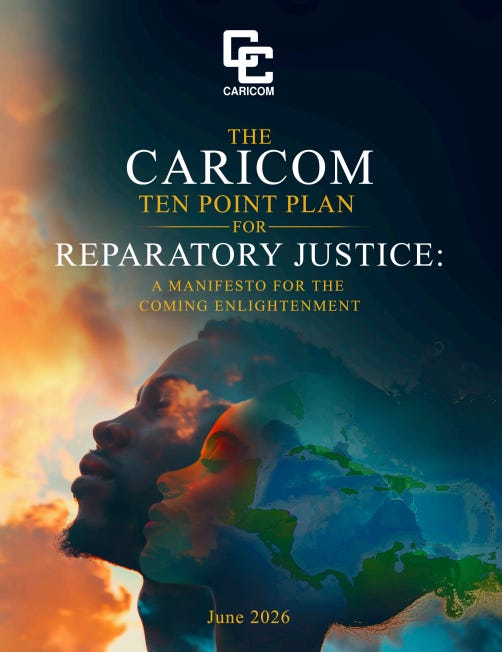
There is a genre of document that announces its own importance in the subtitle, and the Caribbean Community has produced a distinguished example. Its Ten Point Plan for Reparations has been reissued as A Manifesto for the Coming Enlightenment. One admires the reach. Kant asked us to dare to know. CARICOM asks us to dare to pay. The epigraph is Bob Marley, the register is somewhere between a papal encyclical and a fundraising prospectus, and the copyright page is a small masterpiece of unintended comedy. All rights reserved, no part to be reproduced without the prior express permission of the author. A tract denouncing four centuries of property in persons opens by asserting, with some vigour, property in paragraphs.
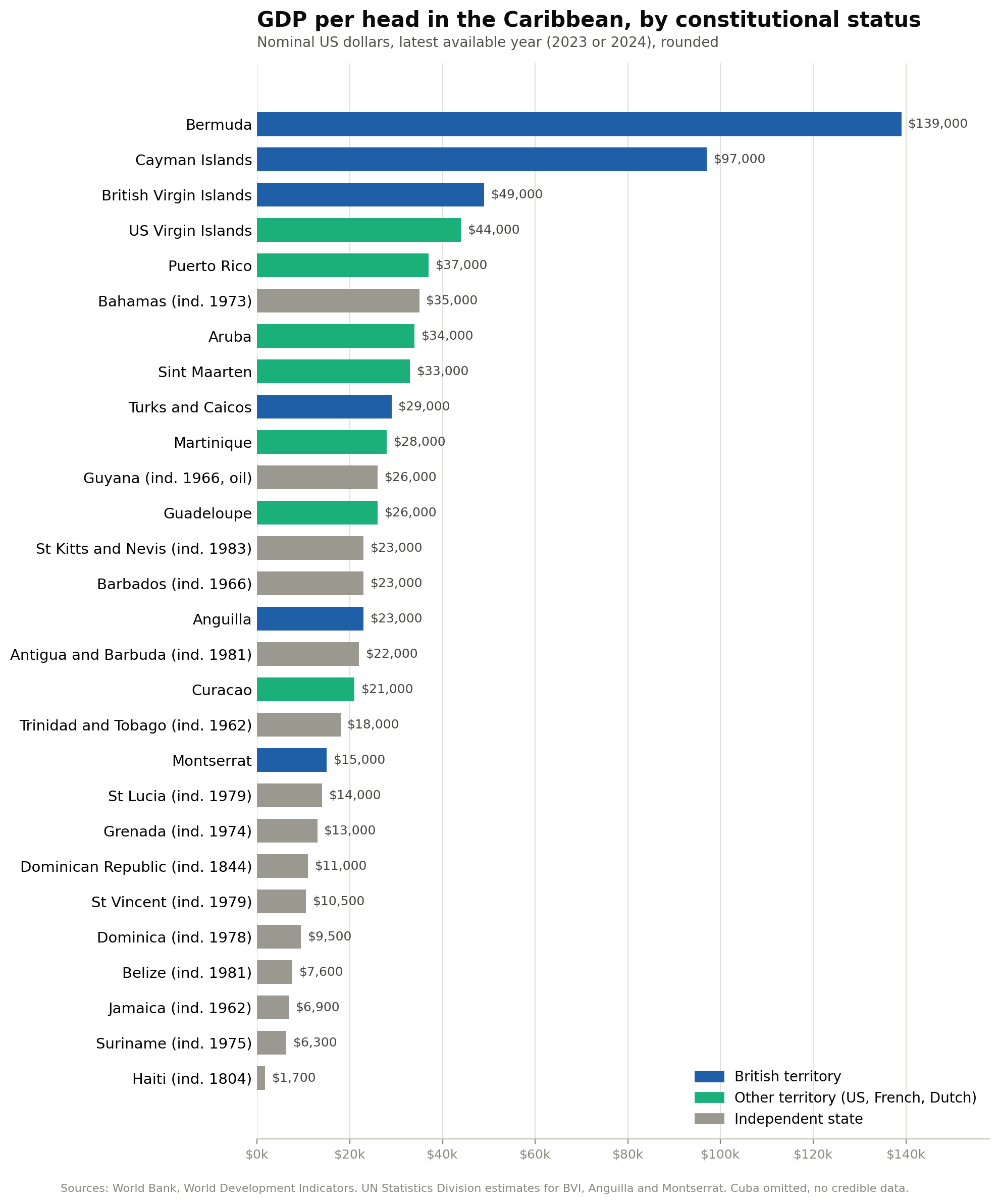
The Commission has spent this week in London hawking the document to MPs, and the claim on which the whole edifice rests arrives, appropriately, in Point Ten, where the money is. “Colonised territories are economically constrained by imposed constitutional arrangements.” Structural economic decolonisation, we learn, must be “infused with the principle and praxis of reparative justice,” a sentence in which no agent acts, nothing is costed, and nothing could ever be declared finished. But leave the grammar aside. The proposition is empirical, and the Caribbean is helpfully arranged as a controlled experiment.
The territories still flying the flag are Bermuda, the Caymans, the British Virgin Islands, the Turks and Caicos, Anguilla and Montserrat. Bermuda enjoys one of the highest incomes per head on the planet. Cayman is not far behind, the BVI and the Turks and Caicos prosper indecently by any regional measure. Now the sovereign column. Haiti broke its chains in 1804, the first free black republic, a nation with two centuries and more of the fullest possible independence, and it is the poorest country in the hemisphere. Jamaica has governed itself since 1962 and spent much of the period since exporting its most talented citizens to Brixton and Brooklyn. Guyana was, until Exxon struck oil, a byword for want. Sovereignty is a noble thing and no serious person begrudges it to anyone who wants it. But the manifesto’s correlation runs precisely backwards. In the British Caribbean, the constitutional arrangement most reliably associated with poverty is the one CARICOM prescribes as the cure.
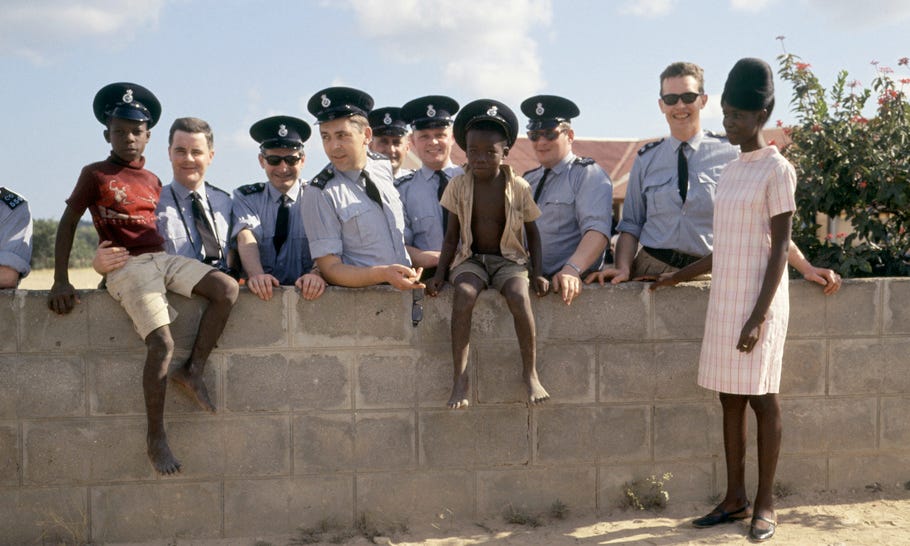
Then there is that word “imposed,” and here the historian reaches, with affection, for Anguilla. In 1967 the Anguillans staged what deserves to be remembered as the most instructive revolution of the modern age. They rose up, expelled the police of newly self-governing St Kitts, and demanded the restoration of direct colonial rule. Whitehall, unable to conceive of such a preference, sent out a junior minister, William Whitlock, who distributed leaflets explaining the benefits of St Kitts and was escorted back to his aircraft at gunpoint. So in March 1969 Britain mounted her last Caribbean invasion, Operation Sheer Lamb, two companies of the Parachute Regiment and a detachment of London bobbies storming ashore at dawn to find the beach occupied chiefly by journalists, who had arrived first, and islanders offering tea. The world’s press called it the Bay of Piglets. The Anguillans called it victory, and they were right. They had fought, more or less alone in the history of decolonisation, for the right to remain colonised, and they won.
Nor was Anguilla eccentric. Bermuda put independence to a referendum in 1995 and roughly three-quarters of those voting declined it. The modern constitutions of the territories were haggled out clause by clause with their own elected assemblies. Full British citizenship came in 2002. Every year the UN Committee on Decolonisation invites these islands to accept a liberty they have not requested, and every year they answer, with the patience of a vicar declining a timeshare, no thank you. The manifesto surveys all this and concludes that the residents are “second-class inhabitants” whose independence “mentalities” are being suppressed. The mentalities are not suppressed. They are consulted at regular intervals and keep returning the wrong answer. To gaze upon a people who have repeatedly voted for an arrangement and pronounce it imposed requires the same instrument once used to explain false consciousness to Polish shipwrights, and it has aged no better in the tropics than it did on the Baltic.
The Commission’s chairman, Sir Hilary Beckles, sharpened the demand at his London briefing. The British Virgin Islands, he announced, should be returned. Returned to whom, one is entitled to ask. The islands’ pre-Columbian inhabitants were destroyed long before the English settled Tortola in 1672, and the present population descends overwhelmingly from people Britain brought there. There is no dispossessed sovereign waiting in the wings, no Kalinago government in exile. Pressed, Beckles explained that his real objection is that Virgin Islanders cannot take fundamental decisions without consulting the Governor and Downing Street, so “return” turns out to mean handing the islands to their present inhabitants as an independent state. The present inhabitants have not asked. The BVI has never held an independence referendum, no BVI government has ever sought one, and the demand was accordingly made not in Road Town by anyone it concerns but in Westminster by a commission from Georgetown, whose manifesto stipulates that the framework will be settled between Caribbean and African leaders before Europe is so much as approached. The islanders appear nowhere in the process. Regional capitals and African Union lawyers will determine the future of a territory whose residents were never consulted, in order to abolish the practice of determining territories’ futures without consulting their residents.
The timing, moreover, is exquisite. The gubernatorial oversight Beckles resents was last exercised in earnest in 2022, after the islands’ elected Premier was arrested at Miami airport in a cocaine trafficking sting and a Commission of Inquiry found the territory’s governance rotten to the waterline. Even then, offered the choice, the islanders preferred reform under the flag to the exit. The African Union’s lawyers are meanwhile reported to be preparing an approach to the International Court of Justice modelled on Chagos, which rather gives the game away. Chagos ended with the islands passed not to the Chagossians but to Mauritius. “Return”, in this vocabulary, means the transfer of territory between governments over the heads of its inhabitants, which is as serviceable a definition as any of the thing it purports to abolish. I.e. regional colonialism.
The dating of the document is not difficult, for anyone who lived through the 1970s will recognise the furniture at once. The extractive core and the bleeding periphery. The demand for technology transfer, here upgraded to “unrestricted access to scientific knowledge, patents and high-tech industries.” The Global Reparations Fund, the reform of the international financial architecture, the summits begetting declarations begetting summits, Accra unto Addis Ababa, each hailing the last as historic. This is the New International Economic Order of 1974 with the serial numbers filed off, the authentic sound of the Non-Aligned Movement in its Havana pomp. The theory had its laboratory. Michael Manley ran it in Jamaica, and the results were capital flight, empty shelves, and his own celebrated observation that there were “five flights a day to Miami” for anyone who disliked it. Over 200,000 Jamaicans took up his offer of an escape from his adolescent Communist paradise, permanently depleting his island of the medical, technical and commercial expertiese it so desperately needed. The superpower that underwrote the original production has left the theatre. The libretto plays on, word-perfect, at the University of the West Indies.
The scholarship has, if anything, ripened. We are informed that the Caribbean’s epidemic of prostate cancer may reflect the selection of high-testosterone men by the Middle Passage, a hypothesis that manages to be both unfalsifiable and faintly Victorian. We are asked to fund “drugs created specifically for black communities,” racial pharmacology of a kind that would end careers were it proposed in Whitehall. Best of all, a “growing literature” suggesting Africans reached the Caribbean before Columbus “is being reviewed for integration into the popular historiography.” Savour the verb. Not tested, not weighed. Integrated. History here is not what happened but what the commission, in its wisdom, decides to canonise, and Sellar and Yeatman could not have put it better. Made up history is so much more conducive to entropy than reality.
As for the bill, the manifesto’s own estimates run from £7.5 trillion to $24 trillion, the higher figure being roughly eight times the annual output of the United Kingdom, and the mechanism matters more than the sum. Every concession is banked, reclassified as a down payment, and entered in an appendix that reads like a mediaeval tribute roll. The Church of England’s £100 million is logged as a prelude. The apologies of Kings, banks and mortified county families are instructed to “cascade into creative reparatory conversations.” Nothing can ever suffice, because the grievance is the endowment, and the commissioners, envoys, professors and expert committees who administer it have no more interest in extinguishing it than a cathedral chapter has in disproving its relic. Kipling saw it a century ago. Once you have paid him the Dane-geld, you never get rid of the Dane.
One can hardly blame CARICOM for persisting, given the customer. For two years the British establishment has conducted itself like a man who answers every begging letter by return of post with his bank details. At the Commonwealth summit in Samoa the last Prime Minister spent a week insisting the conversation would not happen, then signed a communiqué agreeing that its time had come. The King muses in the same key and opens the Royal Archives to the prosecution. Glasgow University now offers a Masters degree in Reparatory Justice Studies, a qualification whose only conceivable employment is the manufacture of further claims. The Trevelyans and the Gladstones tour the studios performing hereditary contrition, flagellants without the discomfort. Each genuflection is recorded by CARICOM as momentum, which, in fairness, it is. This is a governing class that experiences international law as conscience and its own electorate as embarrassment, that finds the approval of Geneva warmer than the interests of Grimsby, and that has quietly forgotten that the first duty of a state is owed to the living.
If history must be run as a ledger, run the whole ledger. Britain abolished the trade in 1807 and the institution in 1833, then spent six decades and, by sober scholarly estimate, close to two per cent of national income a year hunting other nations’ slavers off West Africa, Palmerston harrying the Brazilians into abolition at gunpoint, Royal Navy sailors dying of yellow fever off Lagos to free men to whom they owed nothing. No invoice was raised. The sane conclusion is not that the Caribbean owes Portsmouth a monument, though the case could be made, but that a civilisation which begins totting up ancestral crimes at compound interest will find every hand in every pocket and no terminus this side of the Last Judgement.
Which brings us to Monday, when Andy Burnham walks into Downing Street trailing a reputation for plain speaking earned at Hillsborough and burnished against the Treasury.
Here is a plain sentence with which to begin. The answer is no. No lawyered apology to be produced later in litigation, no fund, no envoy, no “meaningful conversation,” which is the diplomatic term for surrender by instalments.
Friendship with the Caribbean, gladly, trade, hurricane relief, frigates against the narcos, all of it, freely given between sovereign equals. Tribute, never. He should say it in his first week, before the machine explains that no is not a word recognised in international fora, and if he wants a precedent he might look to Anguilla, where a small people knew exactly what they wanted and said so without a manifesto.
The chancers and shysters of the Coming Enlightenment should be told, with every courtesy the English language affords, where to get off. This country paid its ancestors’ debts in blood and treasure long ago, and our people are entitled to a government that knows it.
Another masterful exposition by Gawain Towler. Your righteous defence of our kingdom remains constant. Your efforts admirable. We sleep a little deeper whilst you remain on watch.
God Bless
No
Non
Nein
Nyet
I am not sure for whom I have the most contempt - the shameless racist grifters holding out a begging bowl with menaces, or the supine, pathetic, muddled, woke creatures who ‘lead’ us and who hand over ever-increasing amounts of taxpayers’ cash!
Of course, the number of taxpayers who are actual net contributors to the UK economy is declining at a rate faster than our import of third world dependents is growing - perhaps the two are linked?
Thank you for another impressive article, Gawain; I believe it accurate to state that the Labour Party has sufficient Labour MPs from ethnic minority backgrounds to eliminate its current majority.
I suppose we should ‘go figure’ and decide to either grin & bear it or vote Reform UK.