
St Mary's, Fairford
An accidental pilgrimage

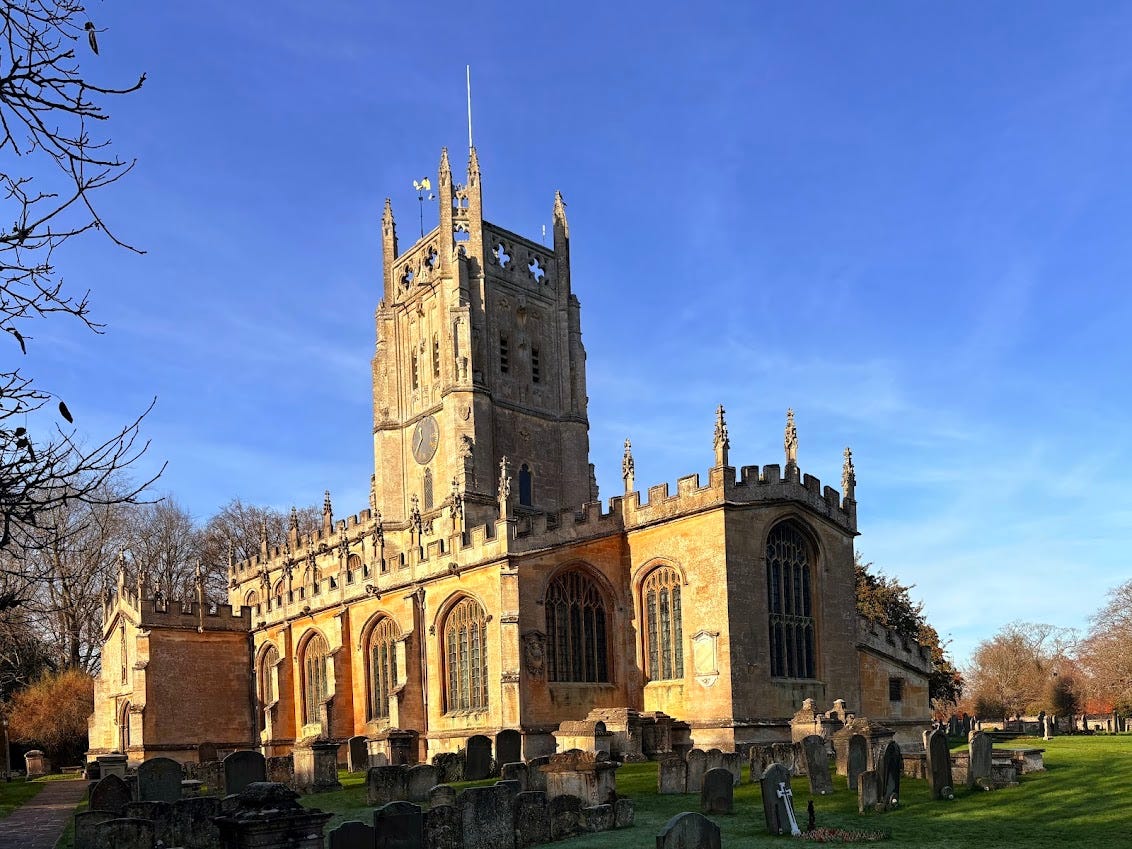
It was one of those crisp, bright late autumn days in south east Gloucestershire, the kind where the sun hangs bright and low, casting long shadows over the golden Cotswold stone, and the air carries that faint, earthy tang of fallen leaves. Late November, and I’d found myself with a few idle hours between an event in Oxford and a drive to Wiltshire. It was a church crawling sort of day, and spotting a sign for Fairford, a quiet market town I’d barely heard of, I pulled over on a whim, completely oblivious to the treasures lurking within its parish church.
St Mary’s, as it turned out, is no ordinary village pile, it’s a revelation, a hidden gem of medieval splendour that left me pondering the fragility of our cultural inheritance long after I’d departed. I wandered in, expecting perhaps a quick glance at some dusty pews, and emerged hours later, humbled by the weight of history and artistry that had survived against all odds.
Fairford itself is a modest place, nestled in the Upper Thames Valley, its fortunes once tied to the wool trade that enriched so many Cotswold towns in the late Middle Ages. Sheep grazed these meadows, their fleeces spun into wealth that built grand houses and churches across the region. It was this prosperity that prompted John Tame, a savvy wool merchant born around 1430, to rebuild St Mary’s in the 1490’s. The original church dated back to Norman times, foundations from the 13th century still peek through in spots, but John, flush with trade profits, and a sense of his own place in history, demolished most of it to create something grander. He spared the early 15th-century tower, raising it with ornate pinnacles and buttresses, and fashioned the rest in the Perpendicular Gothic style that defines so much of England’s finest ecclesiastical architecture.
The result is a compact, almost intimate space: a nave flanked by aisles that extend seamlessly into the chancel, all under a wooden roof adorned with 69 carved angels, their wings outstretched as if in eternal vigilance. The south porch, elaborate fan vaulted with its parvise above, opens into a light-filled interior where every detail, from the chequered marble floor to the exquisite rood screen, speaks of costly devotion. Consecrated in 1497 by the Bishop of Worcester, it was John’s son, Edmund Tame, who saw the project through after his father’s death in 1500. The Tames weren’t aristocrats; they were self-made men, embodying that sturdy English entrepreneurial spirit that once made this nation great.
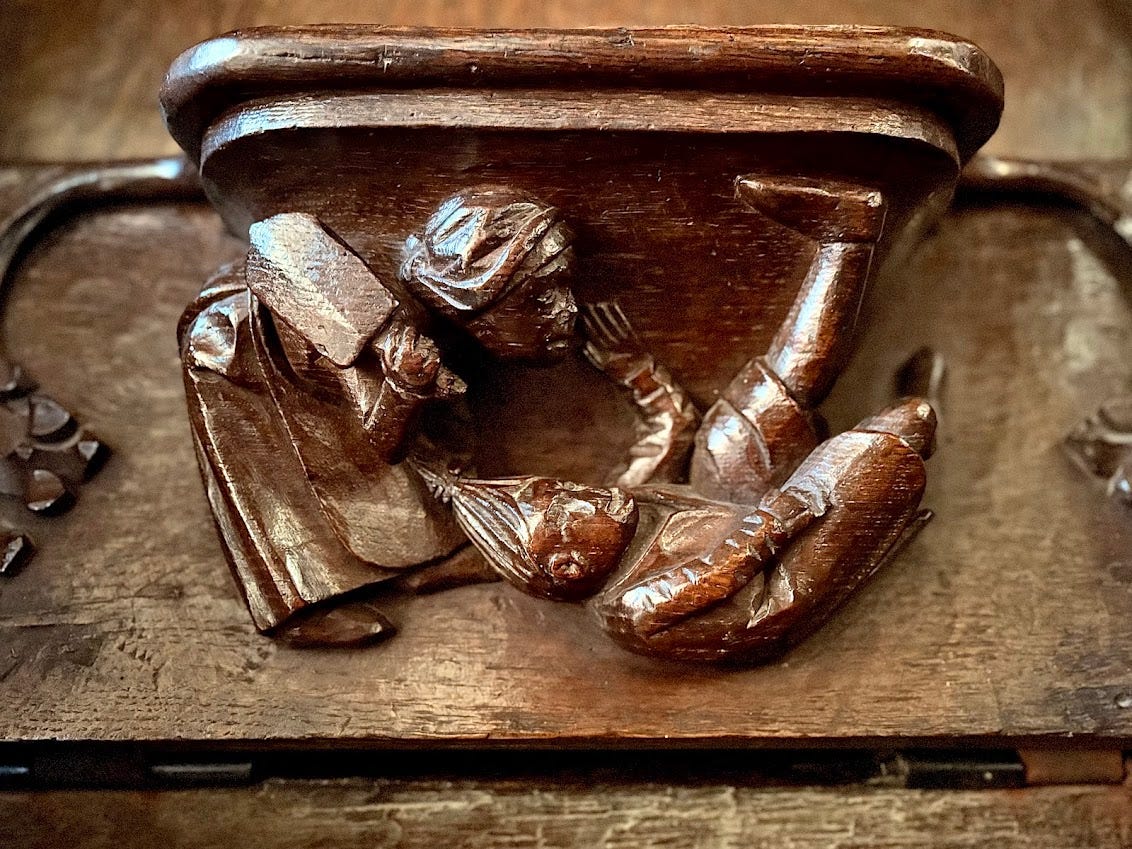
Stepping inside, I ignored the immediately obvious to deliberately focus on the fittings: beautiful, intricate, and remarkably preserved. The chancel boasts fourteen elaborate misericords, those merciful folding seats for weary monks during long services, carved with whimsical, often secular scenes. Medieval Donald McGill postcards. One depicts a woman vigorously beating her husband with a distaff, a cheeky nod to domestic realities amid the sacred. Others show mythical beasts or foliage, their wood worn smooth by centuries of use, likely salvaged from nearby Cirencester Abbey after the Dissolution.
Then there are the tombs, poignant reminders of the church’s patrons. John Tame’s (d.1500) founder tomb, a grand Purbeck marble chest in the Lady Chapel, features brasses of him and his wife Alice Twynyho, who predeceased him in 1471. They stand facing each other, he though a merely a merchant dressed in the most fashionable armour, she in a wired headdress, with heraldic shields and a Latin inscription pleading for prayers: “For Jesus’ love pray for me, I may not pray now pray ye.”
Nearby, the Lygon tomb holds the effigies of Katherine Denys (died 1584), widow of Sir Edmund Tame (John’s grandson), who remarried Roger Lygon. Life-sized and recumbent, they lie in Elizabethan finery, a bridge between medieval and Tudor eras. .
But the glass! The stained glass is the true wonder of St Mary’s: and not just St Mary’s a collection of global artistic importance. A kaleidoscope of colour that bathes the interior in ethereal light. Twenty-eight windows, the only complete set of late medieval stained glass in a British parish church, depicting biblical narratives from Creation to Last Judgement. Commissioned by the Tames , John began it, though died before seeing a single pane fired. Edmund oversaw its completion, the designs are credited to Bishop Richard Fox, Lord Privy Seal under Henry VII and a towering figure in Tudor politics.
Fox, who served as Bishop of Exeter, Bath and Wells, Durham, and finally Winchester, was a diplomat extraordinaire, negotiating treaties and founding Corpus Christi College, Oxford. In Durham, he rebuilt the castle’s great hall and endowed schools; his influence extended to ecclesiastical art, collaborating on King’s College Chapel in Cambridge. At Fairford, his hand is evident in the sophisticated iconography, blending Flemish realism with English themes.
The glazing itself was the work of Barnard Flower, the King’s glazier to Henry VII, assisted by Flemish craftsmen whose expertise infused the panels with Renaissance vibrancy. It took over a decade, from 1500 to 1517, to complete, each window a masterpiece of leaded panes, painted with exquisite detail: flowing robes, expressive faces, dramatic gestures. The Great West Window, showing the Last Judgement with St Michael weighing souls and demons dragging the damned to hell, is particularly harrowing, its top section restored after a 1703 storm but still potent.
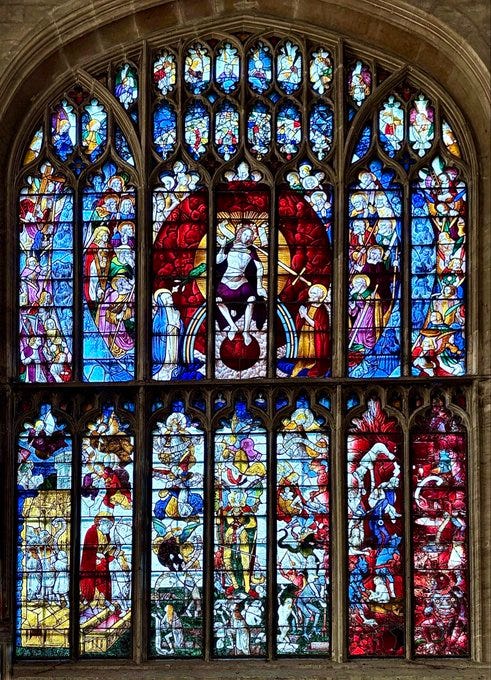
What elevates the glass beyond mere artistry are the Tudor portraits woven subtly into the biblical scenes, a clever nod to contemporaries that would have been obvious then but requires a keen eye now. Elizabeth of York appears as the Queen of Sheba; Catherine of Aragon, Henry’s first queen, as the Virgin Mary in the Annunciation; Prince Arthur, her ill-fated husband, as one of the Magi. Young Prince Henry, later Henry VIII, who visited Fairford as king, is depicted as the boy Jesus in the Temple, his cherubic face foreshadowing the monarch’s later girth. Princess Margaret Tudor attends as a dove-bearing figure; Princess Mary as one of the three Marys at the Resurrection. Even Henry VII himself climbs towards the Gates of Heaven, while Sir Edmund Tame might be among the apostles. Other figures, Cardinal Wolsey, Bishop Fox himself, perhaps Henry VI, add layers of political allegory. These weren’t overt; they flattered the crown while asserting local ties, possibly a royal gift after Henry VII seized Fairford from the executed Earl of Warwick.
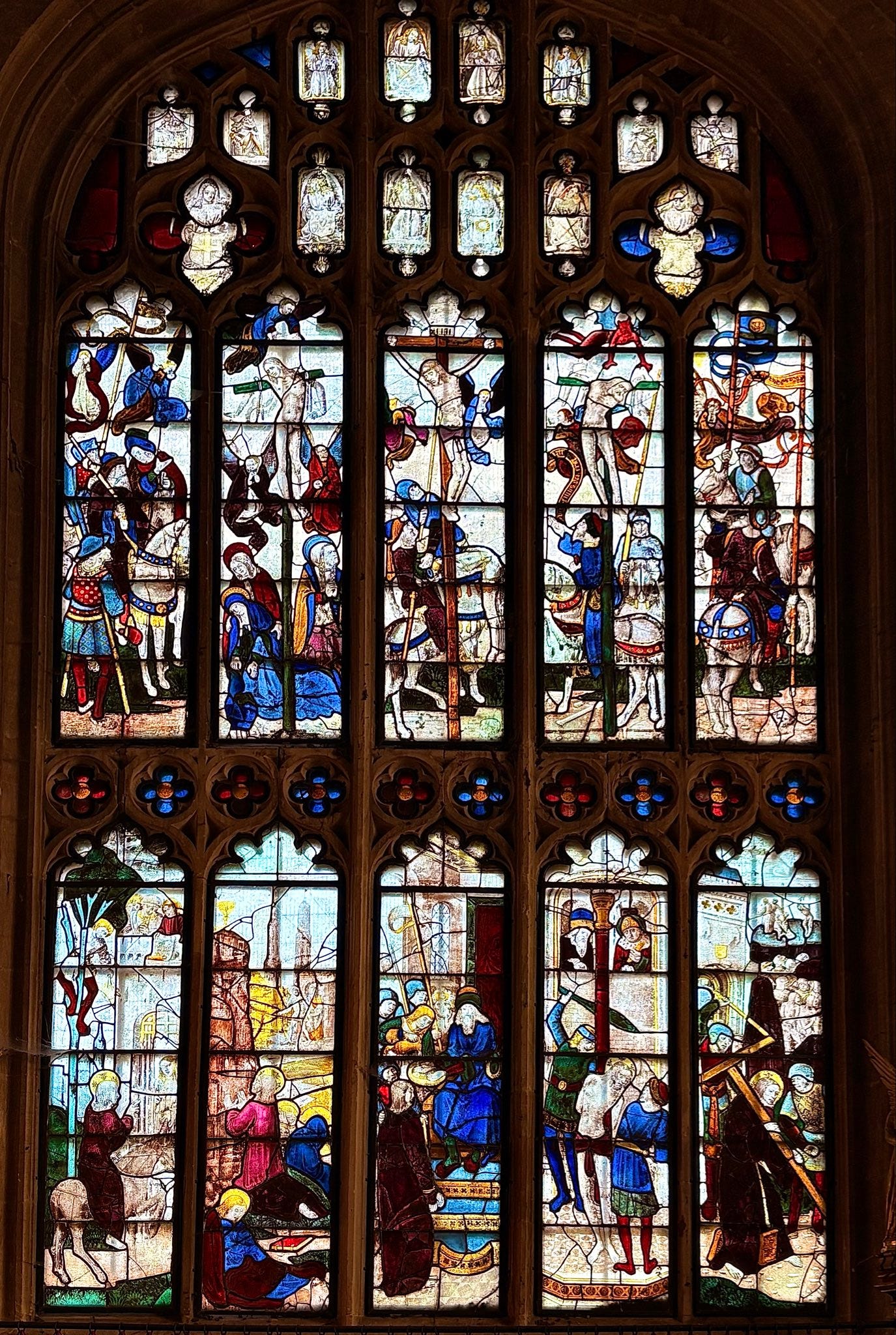
The glass’s survival is nothing short of miraculous. Under Edward VI’s Protestant zeal, many churches lost their “idolatrous” images; Fairford’s were whitewashed over, preserving them beneath layers of lime. During the Commonwealth, as Roundhead puritans rampaged, quick-thinking lessee, one William Oldysworth, dismantled and buried them nearby, restoring them at the 1660 Restoration. In World War II, with RAF Fairford, then a base for American bombers, just miles away, the panes were removed in 1939 and hidden in the cellars of Fairford Park manor house, safe from Luftwaffe raids that never came. A conservation effort from 1988 to 2010 ensured their brilliance endures.
As I marvelled, a kindly local volunteer, a steward from the parish, no doubt, appeared at my elbow. He offered just the right tidbits: pointing out a demon’s smirk or a hidden royal face, then retreating gracefully, sensing my desire for solitary reflection. No hovering, no lectures, just quiet expertise that enhanced the pilgrimage without intruding. In a world of overzealous guides, his tact was a blessing.
Standing there, enveloped in that radiant glow, I couldn’t help but contemplate the glory of this place – and the tragedy, the outrage, of what we’ve lost elsewhere. St Mary’s glass illuminates not just scripture but the soul of pre-Reformation England: a society where faith, art, and community intertwined in ways that fostered beauty and continuity. Yet across the kingdom, countless similar schemes, perhaps not of this superlative quality, but beautiful and meaningful nonetheless, were smashed by iconoclasts in fits of ideological frenzy.
Henry’s Dissolution stripped abbeys bare, looting treasures to fund wars and courtly excess; Cromwell’s men whitewashed frescoes and shattered statues, erasing centuries of craftsmanship in the name of “purity”; Puritans under the Commonwealth went further, vandalising windows and altars in thousands of churches, driven by a self-righteous zeal that brooked no nuance. What remains is a pitiful fraction, a ghostly whisper of the vibrant, colourful world our ancestors built and inhabited, a world where every village church was a gallery of local pride and divine inspiration.
And today? The iconoclasm rages on, more insidious and unchecked, cloaked in the sanctimonious garb of modern “progress.” Black Lives Matter agitators and their fellow travellers in the woke brigade topple statues, deface memorials, and demand the purging of history they neither like nor bother to comprehend. Colston in Bristol, Thomas Guy in Lambeth, Rhodes in Oxford, even Nelson in Trafalgar Square all targeted, smeared, or erased because they jar with the fleeting fashions of contemporary morality.
It’s not reform; it’s cultural arson, a deliberate denuding of our past that leaves us rootless, amnesiac, and vulnerable to whatever narrative the elites deem acceptable. These vandals, fuelled by imported American grievances and amplified by complicit media, attack symbols of our heritage with the same blind fury as the Puritans, but without even the pretence of religious conviction, just a toxic brew of resentment and virtue-signalling. They destroy monuments to explorers, statesmen, and philanthropists, ignoring the complexities of human achievement, and in doing so, they impoverish us all. Our streets, museums, and institutions are stripped bare, our collective memory fragmented, all to appease a minority whose understanding of history is as shallow as their outrage is performative.
One doesn’t have to approve of pre-Reformation theology, its indulgences, its hierarchies, its superstitions, to appreciate, nay, to revere its art, study its culture, and be ravished by its beauty. Nor should we now destroy because our fashions in thought and aesthetics have shifted like treacherous sands under the influence of globalist agendas and identity politics. Understanding requires things to understand: the glass, the tombs, the misericords that connect us to the base humour of our forebears, their triumphs and flaws alike. Now we smash statues, ban books from schools and hospitals and treat, art and music like a modern day concept of degenerate art, fit only for the pyre.
Smash them, and we don’t just lose artefacts; we lose the threads of identity that bind a nation. We become a people adrift, easy prey for those who would rewrite our story to suit their power grabs. It’s infuriating, this cycle of destruction, a reflective anger that boils up from contemplating how much has been lost, how casually it’s been discarded, and how eagerly the modern barbarians continue the work. If we don’t defend these remnants with fierce determination, what will be left for our children but a sterile, homogenised void?
Leaving St Mary’s that autumn afternoon, the sun dipping behind the tower, I felt not just a quiet fury, but a surging, contemplative rage at such vandalism, past and present. A rage born of love for what was built, grief for what was destroyed, and defiance against those who would finish the job today. But also gratitude, for the Tames’ vision, for the survivors who protected this treasure, and for serendipitous discoveries that remind us what endures.
Fairford isn’t just a church; it’s a bulwark against forgetfulness and erasure. Long may it stand.
It's fantastic
I visited St Mary’s many years ago when I looked lived in Oxfordshire it is truly beautiful. Thank you for the memory. Excellent piece as always Gwain