

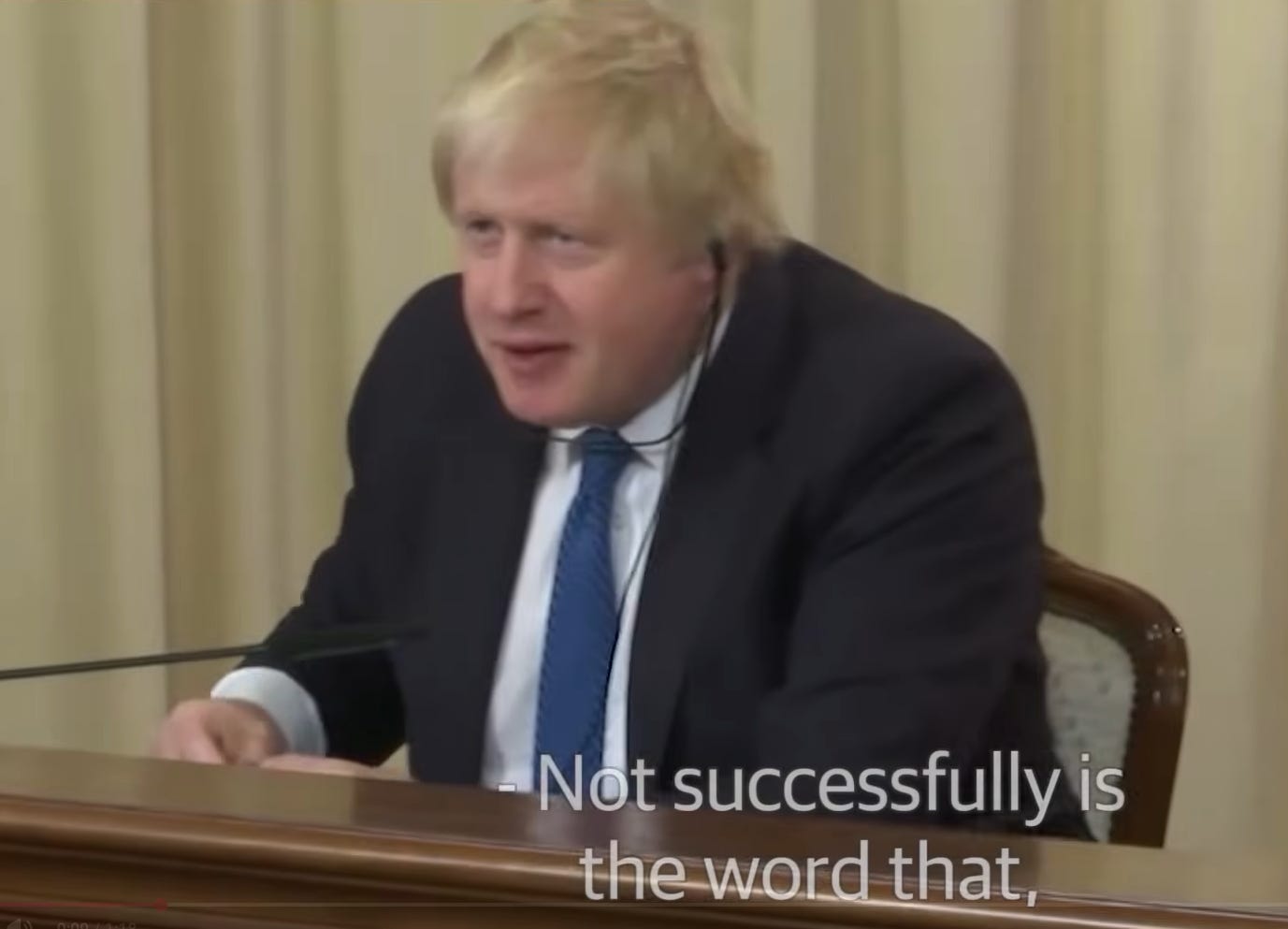
Sergei Lavrov had his line ready. Sitting beside the British Foreign Secretary in Moscow in December 2017, he told the press that his guest had already conceded Russia hadn’t interfered in the referendum. Boris Johnson cut across him. “Not successfully,“ he said, and then said it again, in case the interpreter had ignored it.
Lavrov, who was already a Russian deputy foreign minister while Johnson was in Brussels inventing straight bananas, purred that the poor man feared for his reputation at home. Johnson said it was Lavrov’s reputation that worried him. Then he went off to lay red roses on the bridge where Boris Nemtsov was shot.
Those two words were the British position for the best part of a decade. Russia tried. Russia failed. Nobody in government seriously disputed either half, and Carole Cadwallader and her Remain diehards who did were mostly ignored.
Then on Sunday our new PM Andy Burnham went on a podcast.
The podcast was The Rest Is Politics, which is to say Alastair Campbell and Rory Stewart, which is to say the warmest bath in British broadcasting for a Prime Minister who wants to talk about rejoining the EU. Burnham had just come back from Berlin, where Friedrich Merz had been telling him the AfD were Moscow’s creatures. He offered his hosts something to match.
On arriving in Downing Street, he said, he’d asked whether Russia interfered in 2016, and “I’ve had the clear answer that yes, there was.” He wanted it on the record, he explained, so that voters in France and Germany would understand that some of their politics is instigated by our enemies.
Who gave him the answer? He didn’t say. What evidence? None offered. What kind of interference, and did it change a single vote? Silence. HuffPost ran it as the first time a British Prime Minister had confirmed Russia’s role in Brexit, which is what anyone would take from it, and what it was meant to sound like.
By breakfast on Monday it had come apart. Stephen Doughty, a Foreign Office minister, was put up on LBC and said what the Foreign Office has always said. “We know what the result was. I don’t think they’ve succeeded in their efforts.” He leaned on the security minister, Dan Jarvis, who had already given evidence that Russia attempted and failed. So a minister of the Crown went on morning radio and corrected his own Prime Minister with Boris Johnson’s two words. Lavrov must have enjoyed that.
Number 10 followed him into the bunker. The spokesman called it inconceivable that Russia hadn’t tried to use the referendum, agreed it hadn’t succeeded, and added that the Prime Minister absolutely accepts the result. Nigel Farage, in Dover, was less diplomatic and called Burnham a liar.
Then came the dispatch box. Kemi Badenoch reminded the House that the head of MI5 said in 2018 that he’d seen no evidence Russia influenced the result, and asked whether the Prime Minister now thought it illegitimate. Burnham wincing, told her he had “implied no such thing”, that he was not reopening the referendum, and then changed the subject to Russian meddling in the 2019 general election.
Implied. A man who says he asked a question and got a clear yes has not implied anything. He has asserted it. What he left out was the word successfully, and he left it out for a reason. You don’t warn French and German voters about interference that failed. The whole point of the remark, as he framed it himself, was that it worked here and might work there. Unsay that and the podcast clip is a Prime Minister telling foreign electorates that Russia tried something in Britain ten years ago and got nowhere, which isn’t much of a warning.
Johnson, never one to leave a stage to someone else, walked back on. When he became Foreign Secretary in the weeks after the vote, he says, the intelligence services told him they had no evidence of foreign interference. So one of two things is true. Either the agencies have changed their assessment since, in which case Parliament and the rest of us would like to see the new one, or the Prime Minister is misrepresenting what he was told.
It’s a neat fork, and Burnham can’t sit comfortably on either prong. If the assessment has changed, what changed it, ten years on? If it hasn’t, he dressed up a routine briefing (Russia probes everything, Russia probed this) as a revelation, for a foreign audience.
I’ll be fair to the other side, because the record deserves it. The Intelligence and Security Committee’s Russia report in 2020 was scathing that nobody had gone looking. MI5’s first written submission to the inquiry ran to six lines. Johnson’s government replied that it had seen no evidence of successful interference and that a retrospective assessment wasn’t necessary, and you can argue that “we found nothing” sits awkwardly beside “we didn’t look”. Remainacs have argued it for ten years.
But look at what was actually found in the open. The Commons Library records that RT spent $1,031.99 promoting six referendum posts during the regulated campaign. Vote Leave was allowed to spend £7 million. Seventeen point four million people voted to leave. Moscow’s documented outlay comes to rather less than a hundredth of a cent per Leave voter, and the Pembrokeshire Herald, of all papers, has noticed that much of the Russian-linked online chatter researchers identified came after polls closed. That is the great Kremlin operation that decided Britain’s future.
Of course Russia tried. The ISC said Moscow regards Britain as one of its top Western intelligence targets, and I’d be mildly insulted if it didn’t. A hostile state with a large foreign intelligence service and a state broadcaster will push whatever divides its rivals, in every election and every referendum, from Edinburgh in 2014 to Washington in 2016. Expecting otherwise is like being shocked that foxes visit the henhouse.
And so, I’m quite sure, do we. The Foreign Office ran the Information Research Department for thirty years after 1948, feeding carefully sourced stories to friendly journalists from Lagos to Jakarta. When the Integrity Initiative’s papers leaked in 2018 they showed a Foreign Office-funded outfit cultivating networks of journalists and academics across Europe. Nobody in Whitehall or in Moscow fainted. The BBC World Service is paid for by the same department. Statecraft has always included the manufacture of opinion abroad, and Britain was rather good at it.
So was it naivety or stupidity?
The naivety would be to imagine that “Russia interfered” is news. Every intelligence officer in Europe assumes it of every vote. The stupidity is to announce it as news, in a form your own minister has to correct before the nine o’clock pips, and then to stand at the despatch box claiming you never said it.
I don’t think Burnham is naive, and he isn’t stupid. I think he found the line useful. He had just been in Berlin making the case for drawing Britain back towards Brussels, and Merz had handed him a story about Russian puppets on the German right. Seventeen million British Leave voters made a handy exhibit for it. Nobody asked them whether they minded being cast as Moscow’s dupes to help a German chancellor with his domestic problem.
Watch what the taint is for. If the 2016 result was nudged by Moscow, then it’s a little less sacred, and a little less sacred is all you need to skip asking the people again.
Emily Thornberry has now floated the idea that a line in a Labour manifesto would do the work of a second referendum. Jess Phillips told the Cliveden Literary Festival at the weekend that she’d love rejoining in the next manifesto, and that she doesn’t “run towards having another referendum”. Burnham himself told the BBC after conference that a future referendum pledge was possible, and has conspicuously declined to promise one.
Thornberry has form here, though not the form she’d like remembered. On the Marr programme in November 2018 she said, flatly, “We had a referendum and the results of the referendum ought to be abided by.” On Question Time around the same time she predicted that a second vote would come back Leave, with the public asking whether politicians had heard them the first time. Her party’s 2024 manifesto promised to make Brexit work, which most voters took to mean making it work rather than quietly unpicking it.
I’m no friend of referenda. They’re blunt instruments and they let MPs dodge the jobs they’re paid for. But once you’ve asked the country a direct question and it has answered, only the country can take the answer back. A manifesto is a bundle of three hundred promises voted on for a hundred reasons, and nobody has ever been elected on paragraph forty-seven. Treating one line of it as a mandate to reverse 17.4 million votes is the politics of the small print, and Labour knows it, which is why they need Russia.
If Burnham wants a Russian influence campaign with a paper trail, Maurice Cousins has been pointing at one. It isn’t about a vote ten years ago. It’s about the gas under Lancashire.
Russia’s interest is simple arithmetic. Every cubic metre of shale gas Europe produces for itself is a cubic metre it doesn’t buy from Gazprom, and a Europe that heats itself is a Europe Moscow can’t freeze. So in June 2014 the then Secretary General of NATO, Anders Fogh Rasmussen, told an audience at Chatham House that allies had reported Russia engaging with environmental groups campaigning against shale gas, to keep Europe dependent on Russian imports.
The Americans went further, and they put it in writing. The January 2017 assessment by the US Director of National Intelligence, the same document that set out Russia’s meddling in the presidential election, noted that RT runs anti-fracking programming, and read it as Moscow worrying about American shale and Gazprom’s profits. A House Science Committee staff report in 2018 followed the trail into social media. RT was not shy about bringing the campaign to England either. In January 2017 it ran a breathless piece about frackers threatening the Major Oak in Sherwood Forest, Robin Hood’s old hideout. Putin as protector of the greenwood.
I’ll concede the limits, as I did on 2016. Nobody has shown evidence Russian money reaching British anti-fracking groups. The Ferret’s fact-checkers rated that claim unsupported, the green groups denied it, and Rasmussen later called his remark an interpretation. But the propaganda is documented by the intelligence agencies of our closest ally, and the motive is written on every gas bill in the country.
Burnham might have asked Merz, while he was in Berlin, who handed Moscow the keys to Germany’s gas in the first place. It wasn’t the AfD. Gerhard Schröder signed the Nord Stream deal with Putin in 2005, in his last weeks as an SPD chancellor, and spent his retirement chairing Nord Stream’s shareholders’ committee and sitting on Rosneft’s board. Angela Merkel, leader of Merz’s own CDU, opened the first pipeline in 2011, defended Nord Stream 2 for years as a purely private enterprise, closed the nuclear stations after Fukushima and presided over a law in 2016 that all but banned shale fracking. By 2021 Russia was supplying 55% of Germany’s imported gas, up from 39% a decade before. Asked in 2022 whether she regretted any of it, Merkel said no, and explained that cheap Russian gas had let Germany phase out nuclear and coal.
Read that answer again. The green transition was paid for in roubles, and the people who signed the cheques sat in the chancellery, not on the fringes. When Donald Trump warned the UN General Assembly in 2018 that Germany was making itself dependent on Russian energy, the German delegation was filmed smirking. Merz now tells a British Prime Minister that Russia’s friends sit on the AfD benches. Russia’s most useful friends in Germany wore SPD and CDU rosettes, and they were doing exactly what RT asked.
And look how it turned out. Labour went into the 2024 election promising to ban fracking for good. The Bowland shale stays where it is. Britain buys gas from Norway’s pipelines and from tankers out of Qatar and Texas, at whatever price the world sets that winter. Whether or not Moscow lifted a finger, it got exactly the British energy policy RT spent years asking for, and Burnham’s government is the one delivering it.
So here’s a question for the next time he walks into Number 10 asking what the Russians have been up to. Not the referendum. Ask about the shale.
“Not successfully,” Johnson told Lavrov. Nobody can say that about fracking.
Whether the Russians tried unsuccessfully to influence the 2016 vote is debatable. What is absolutely certain is that the Remainer lobby disgracefully spent 4 years after 2016 trying to frustrate the vote and have never given up trying. Now that is real, undeniable treason. And Burnham, Campbell and Stuart were all part of that.
“Ask about the Shale”
A compelling sign off to yet another exposé revealing the chicanery, shenanigans, dishonesty and egregious self-enrichment of so many of our so-called Western leadership.
Thank the good Lord for Nigel Farage & Co.