
Farage's Vision Thing
A Birmingham Epiphany

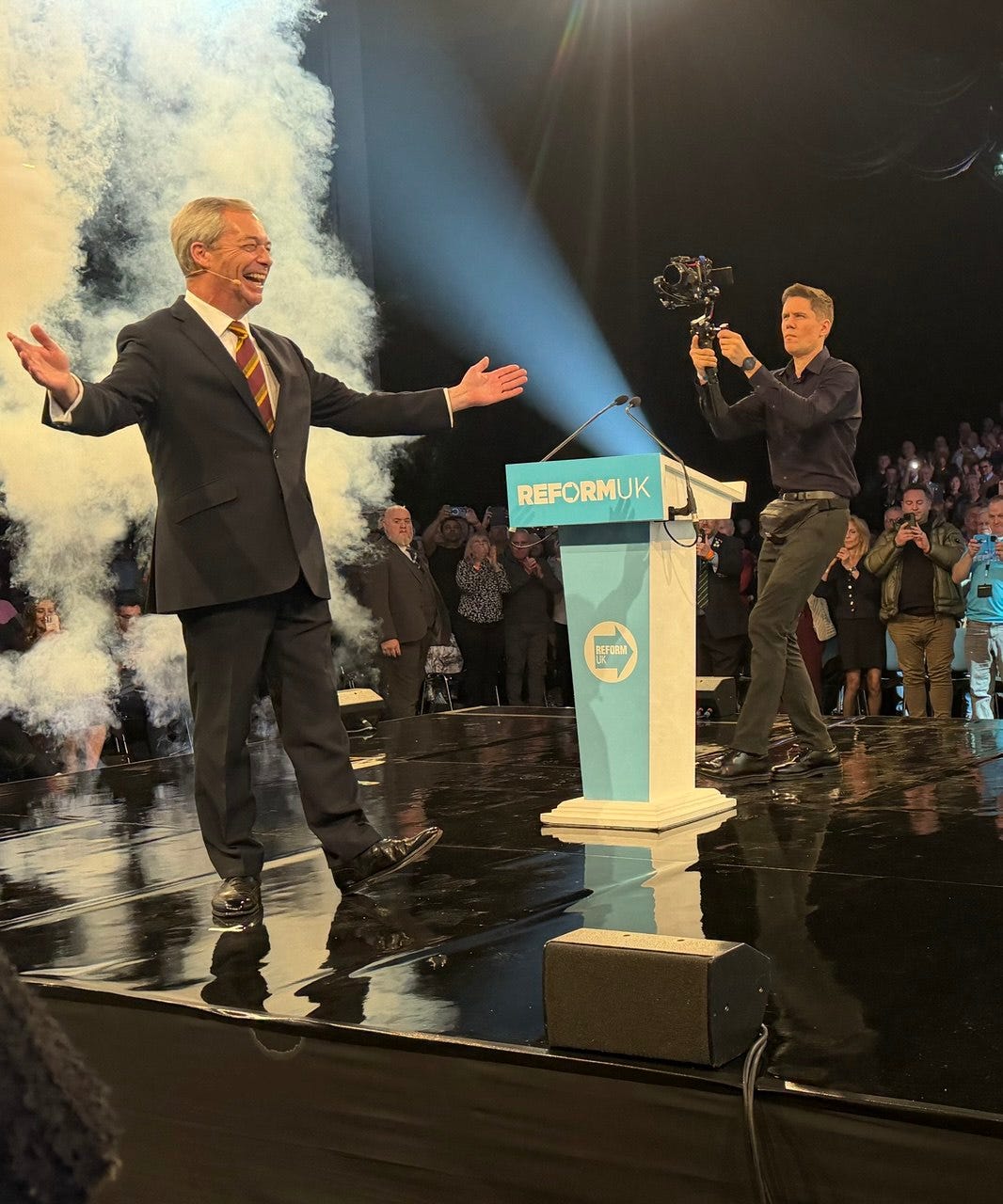
While the world was discovering that the Edinburgh tail fails, once again, to wag the London dog, and while Sir Keir Starmer remains, even as I write, #still our Prime Minister, something quite remarkable happened in Birmingham. Nigel Farage made a speech. His own Tamworth, or shall we say, Pendigo manifesto.
I realise that Farage making a speech is not, on its own, remarkable. For a start, he’s been doing it for more than a quarter of a century, and in more rooms, halls, taverns, and chambers than most travelling salesmen have ever seen. From the fug of a Kent pub to the echoing chill of Strasbourg’s hemicycle, I have probably witnessed over a hundred of them. He is, after all, a natural campaigner, the man who changed British politics without ever troubling the Treasury Bench.
But this, this was different.
The event was billed as the formal relaunch of Reform UK, but it felt more like the unveiling of a post-campaign Farage: less Nigel the insurgent, more Nigel the statesman. He uncharacteristically fluffed a couple of lines, Rachel Reeves, is not the Prime Minister (for which the Lord be praised). He even glanced down at his notes. Now, I’ve seen him do that only twice before: once in Paris, in 2005 (the speech was in French after all). If Farage, the unflappable pub orator, feels the need to check his lines, you know he thinks it matters.
From the opening, it was vintage Farage rhetoric retooled for a new age. Gone was the winking insurgent. Here was a man sketching something far broader, a manifesto for what he clearly hopes is government-in-waiting.
“Britain is broken,” he intoned, in the kind of lugubrious rhythm that only true conviction can provide. “We need not a new boiler part but a brand new boiler.” The metaphor, while as clunky as an old Worcester Bosch, struck home. Farage was not there to tinker. He was there to propose demolition and reconstruction.
Gone were the jokes about bent bananas. In their place: he roamed across policy fields like a spaniel let off the lead, joyous, tireless, and always certain he’s found the scent..
What was consistent, and unmistakably Farage, was his central lodestar: the national interest.
Over and over, he drove it home. “We will act in the national interest, regardless of criticism,” he said, and the audience, the normal affable mix of the retired, tattooed tradesmen and bright-eyed twenty-somethings (I met one who’d flown from Sydney), nodded along.
When he declared that the country must reject “kowtowing to unelected commissioners” in Brussels or “illegitimate” international courts, the response was rapturous. He may be stepping into a new role, but the chords of sovereignty and self-reliance remain his chosen anthem.
The heart of the speech could be divided into three intertwined themes: national revival, economic realism, and cultural renewal.
First came energy: “We will ditch the insane net zero agenda,” he thundered, “and we’ll get the North Sea operating again.” A pragmatic pitch for sovereignty through self-sufficiency, part Thatcherite nostalgia, part defiance of metropolitan eco-piety. Tying this to a blast for agricultural sufficiency, backing our farmers whilst condemning the vast solar deserts to the slop bins.
Then came enterprise: “We will be the champions of have-a-go Britain.” This was Farage the salesman returning to his roots, talking about graft, not graphs.
Education followed, with demands for vocational routes, patriotic curricula, and an end to “poisonous” ideology in the classroom. “Not everyone needs an ’ology’,” he grinned, to approving laughter, particularly in the age of AI.
And then came the moral backbone of the new Farage offering: “family, community, country.” Judeo-Christian ethics, he said, underpin civilisation itself, and Reform would build policy around them. It was the distillation of the small-c conservative creed that the modern Conservatives seem to have forgotten.
Farage’s contempt for what he calls “the Westminster and Whitehall class” radiated like static throughout the speech. “They don’t understand hard work,” he said. “They don’t understand business, and we do.”
To his audience, this is the key. The eternal outsider may be trimmed and tailored for statesmanship, but he has not forgotten the language of revolt. The people in that Birmingham hall didn’t come for managerial competence; they came for a promise that the moral and economic order will be reverted, that the governed might once again have their turn.
It’s a familiar formula; Farage, however, gave it a distinctly British character. His enemies are not faceless elites; they’re the sort who write strategy documents on working from home. “People aren’t more productive at home,” he scoffed. “It’s a load of nonsense. They’re more productive working with other human beings.”
The most striking section, though, was his assault on what he called Britain’s “attitudinal drift.” The country, he said bluntly, has lost its work ethic. “Mild anxiety? after a heavy night out, I have mild anxiety,” he quipped, drawing laughter but also a sense of shared frustration. “You can’t go on the sick because of mild anxiety.” This is classic Farage: the pint as metaphor for productivity; conviviality as civic virtue.
The welfare state, he argued, must shrink if Britain is to thrive. And if cuts must be made to strengthen the armed forces, so be it: “We can’t defend ourselves right now, and we need to be able to.”
It was the kind of plainspoken trade-off no party leader seems willing to articulate. Whether you agree or not, the clarity was bracing.
By the end, you could almost hear the tectonic plates of Reform UK shifting. This was no longer a fringe movement begging for oxygen. It was an embryonic government preparing its pitch to a weary nation.
Farage’s tone carried less of the “cheerful heresy” that’s made him famous, and more of the gravity of responsibility. There was even something approaching magnanimity in his brief reflections on Starmer, though it was, naturally, a magnanimity offered from the victor’s corner.
And that’s what made the moment uncanny.
For the first time, you could see Farage imagine himself not just as Britain’s conscience, but as its captain. The eternal protester is now making the seditious leap towards leadership.
In Birmingham, Farage redefined the terms of British reform. Once, Reform was a slogan. Now, it looks suspiciously like a programme for government. Strangely Australian in its, “Have a Go”, “Fair Go”, feeling
The energy may have shifted from Leave the EU to Fix the Country, but the instinct remains the same: a deep, furious love of Britain coupled with a theatrical disregard for those who run it poorly.
And whether you loathe him, love him, or wish he’d just go back to LBC, you have to admit: Nigel Farage is once again setting the weather.
The Birmingham speech marked the moment he stopped being a political meteorologist, and started auditioning to be the storm itself.
What a belter of an article! You capture the sense of Farage’s pitch at NEC perfectly…I had not properly appreciated the shift but now get it clearly. Thank you. Your final sentence is solid gold.
Excellent reflection, truly great speech from Nigel. Where /why has the membership ticker gone on the website? It has proved a good barometer of reaction to events.