
A Drive Through the Levels
Pitchfork echoes on Sedgemoor

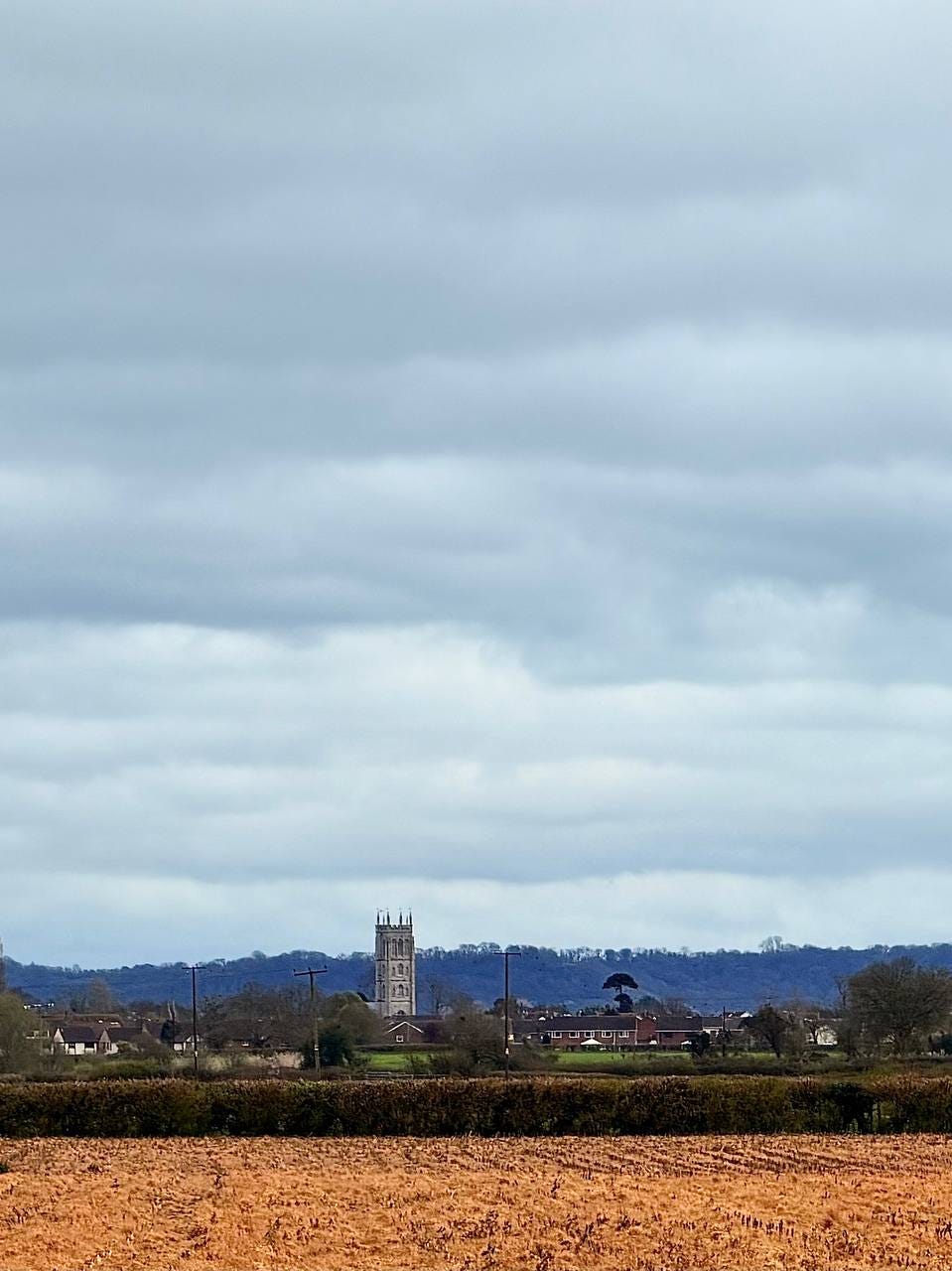
The road unspools like a ribbon across the Somerset Levels, that vast, once-waterlogged plain that still whispers of its marshy past even as the drains and the modern tarmac try to silence it. I was heading ultimately for St Austell, that clay-and-granite corner of Cornwall where the flooded china clay pits gleam turquoise under the Atlantic sky. But the route took me first through Wiveliscombe, a sturdy little market town with its buried bishop’s palace and its air of quiet antiquity, about which more, perhaps, another day, but before then, deliberately via Norton St Philip, down onto the Levels themselves. My quarry was not some grand estate or tourist honeypot, but three unassuming parish churches: Westonzoyland, Middlezoy and Chedzoy. They sit like sentinels on their low ridges, the “Zoylands” that once rose as islands above the flood. The drive is flat, the sky enormous, the hedgerows giving way to open pasture where cattle stand knee-deep in the lingering damp. One feels, even now, the ghost of water everywhere.
I parked first at Westonzoyland, St Mary the Virgin, its tall Perpendicular tower a landmark against the Levels’ horizon. The church is a fine thing, late medieval work of the sort Somerset does so well, carved angels on the roof beams, a screen that has seen five centuries of prayer. Inside, the light falls softly through clear glass, and one can still sense the weight of what happened here. But more of that later. Then on to Middlezoy, Holy Cross, smaller, older in feel, with its sturdy nave and the quiet dignity of a building that has outlasted kings and rebellions alike. Chedzoy, St Mary, completed the trio, another graceful Somerset tower, another patch of sacred ground where the Saxons first raised a cross and the medieval masons added their stonework. These are not grand cathedrals; they are the working churches of farming folk, yet they carry the memory of England in their very fabric.
The name “Zoy” itself is ancient. It derives from the old “Sowy,” the name given, probably before the Conquest, to this raised tongue of land between the rivers Cary and Parrett, one of the “islands” in the great wetland of the Somerset Levels. Westonzoyland was the western settlement on that island when the single parish of Sowy was carved up in 1515; Middlezoy the middle; Chedzoy, perhaps, Cedd’s island. Glastonbury Abbey had long held sway here, draining, farming, building. The Levels were treacherous then, impassable in winter, a labyrinth of meres and withies. And just a few miles away lies another “island”, Athelney, where Alfred the Great took refuge in the marshes in 878, forging the resistance that would become the kingdom of England. One can stand in these churchyards and feel the long continuity: Saxon thegns, Norman lords, medieval abbots, all shaping the same low-lying land that the sea once claimed and that men, with infinite labour, reclaimed.
The churches themselves bear the marks of that long labour. Westonzoyland’s tower dates to the late fifteenth century, its fabric enriched by the wool wealth that once flowed through these parts. Middlezoy and Chedzoy show earlier work, thirteenth-century arches, fourteenth-century windows, but all were beautified in the great Somerset wool rebuild of the late Middle Ages. They were not merely places of worship; they were the hearts of their communities, where tithes were paid, disputes settled, and the dead laid to rest beneath the Levels’ clay. Yet for all their antiquity, it was not the medieval past that drew me most sharply on this drive. It was the summer of 1685, when these quiet fields ran with blood and these very churches became prisons and makeshift hospitals in the last pitched battle fought on English soil.
The pivot comes easily here, standing on the edge of the moor. For these villages lie at the heart of the story of the Monmouth Rebellion, that strange, doomed Protestant rising against the Catholic James II. James Scott, Duke of Monmouth, was Charles II’s eldest illegitimate son, handsome, charismatic, Protestant to his bootstraps. He had served the crown loyally enough; in 1679 he had commanded the royal forces that crushed the Scottish Covenanters at Bothwell Bridge. Yet by the early 1680s he had grown disillusioned. His uncle, now James II, was sliding ever more openly towards Catholicism, and Monmouth feared the consequences. England was still traumatised by the Civil War and the grim, puritanical years of the Cromwellian Commonwealth. Another religious civil war was the last thing the country needed. Yet Monmouth, sensing the tide of Protestant anxiety, chose to act. Why the West Country? He had toured it before, to popular acclaim; it was a hotbed of dissenting religion, of clothworkers and farmers who remembered the old faith with suspicion and who still sang the psalms of the Reformation. Lyme Regis would be his landing place.
He came ashore on 11 June 1685 with a handful of followers, eighty-two souls, they say, and a few ships’ guns. The rebellion began small but swelled like a summer flood. From Lyme they marched through Bridport (a sharp skirmish there), Axminster, Ilminster, to Taunton, where Monmouth was proclaimed king by an enthusiastic crowd. By the time they reached Bridgwater his army numbered thousands, mostly local lads, farmhands, weavers, armed with scythes and pitchforks as much as muskets. They gathered powder and shot where they could. Hopes ran high. But the tide turned. An attempt to seize Bristol failed, Bath gave him a rebuff.
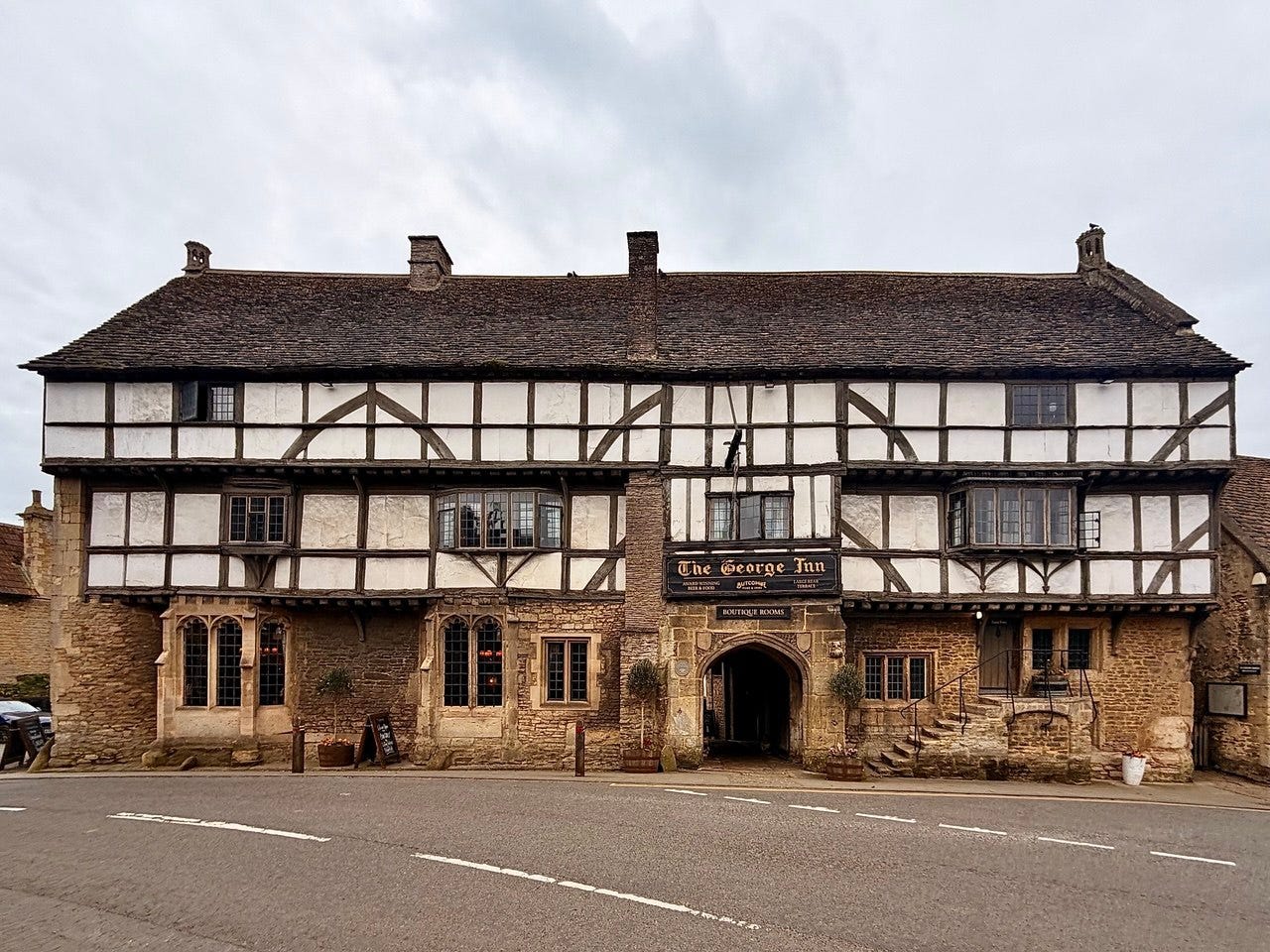
A brisk fight at Norton St Philip, after Monmouth had been shot at through the window of the George, England’s oldest (provable) pub as he was shaving, though a winning draw, saw more desertions. The rebel force, now dwindling, fell back on Bridgwater, Monmouth’s “rebel town”, where he could look out across the moor and see the royal army encamped at Westonzoyland.
That army was commanded by Louis de Duras, 2nd Earl of Feversham, a French-born soldier of fortune who had made England his home. Naturalised in 1665, nephew to the great Marshal Turenne, he was a professional through and through, loyal, if not inspired. With him was John Churchill, already a rising star, who had served alongside Monmouth years earlier. In 1673, at the siege of Maastricht in 1673, both had fought in the French service against the Protestant Dutch of William of Orange. Churchill had been badly wounded; the two men knew each other’s measure as soldiers. Churchill, the son of a Dorset squire, was already showing the cool professionalism that would later make him the greatest captain of his age.
The night of 5 July 1685 was warm and still. Monmouth led his men out of Bridgwater in a daring surprise attack. Guided by locals, they crossed the moor by lantern and starlight, aiming to fall on the royal camp before dawn. They nearly succeeded. But the Bussex Rhine, that wide, deep drainage ditch, proved their undoing. A pistol shot alerted the sentries. Feversham’s regulars formed up with parade-ground precision. Churchill’s infantry held the line. Royal artillery and cavalry did the rest. By morning the moor was littered with the dead. Perhaps a thousand rebels fell; the royal losses were under a hundred. Monmouth fled, to be captured days later and beheaded on Tower Hill. The rebellion was over.
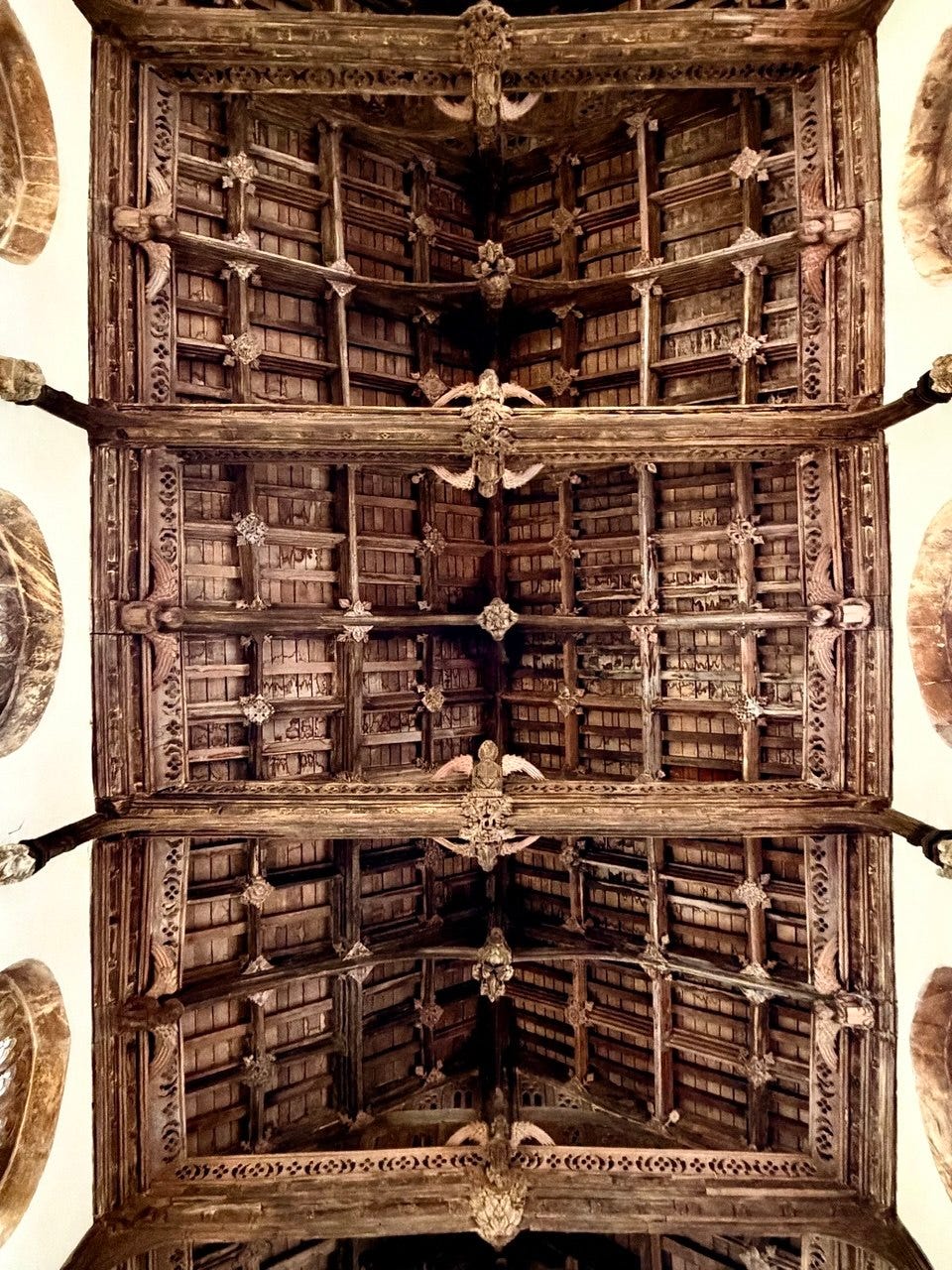
The aftermath was written into these very churches. Westonzoyland’s St Mary became a prison. Some five hundred captured rebels were herded inside, wounded, terrified, packed so tightly that many died of their injuries or the stifling heat, whilst mute angels looked down upon them. The churchyard saw summary hangings. Middlezoy, meanwhile, served as a hospital for the royal wounded. And there, in the chancel of Holy Cross, one finds the grave of Louis Chevalier de Misiers, a French gentleman who had served eighteen years in the English Foot Guards. The inscription is worth quoting in full, for it speaks with the blunt gallantry of the age:
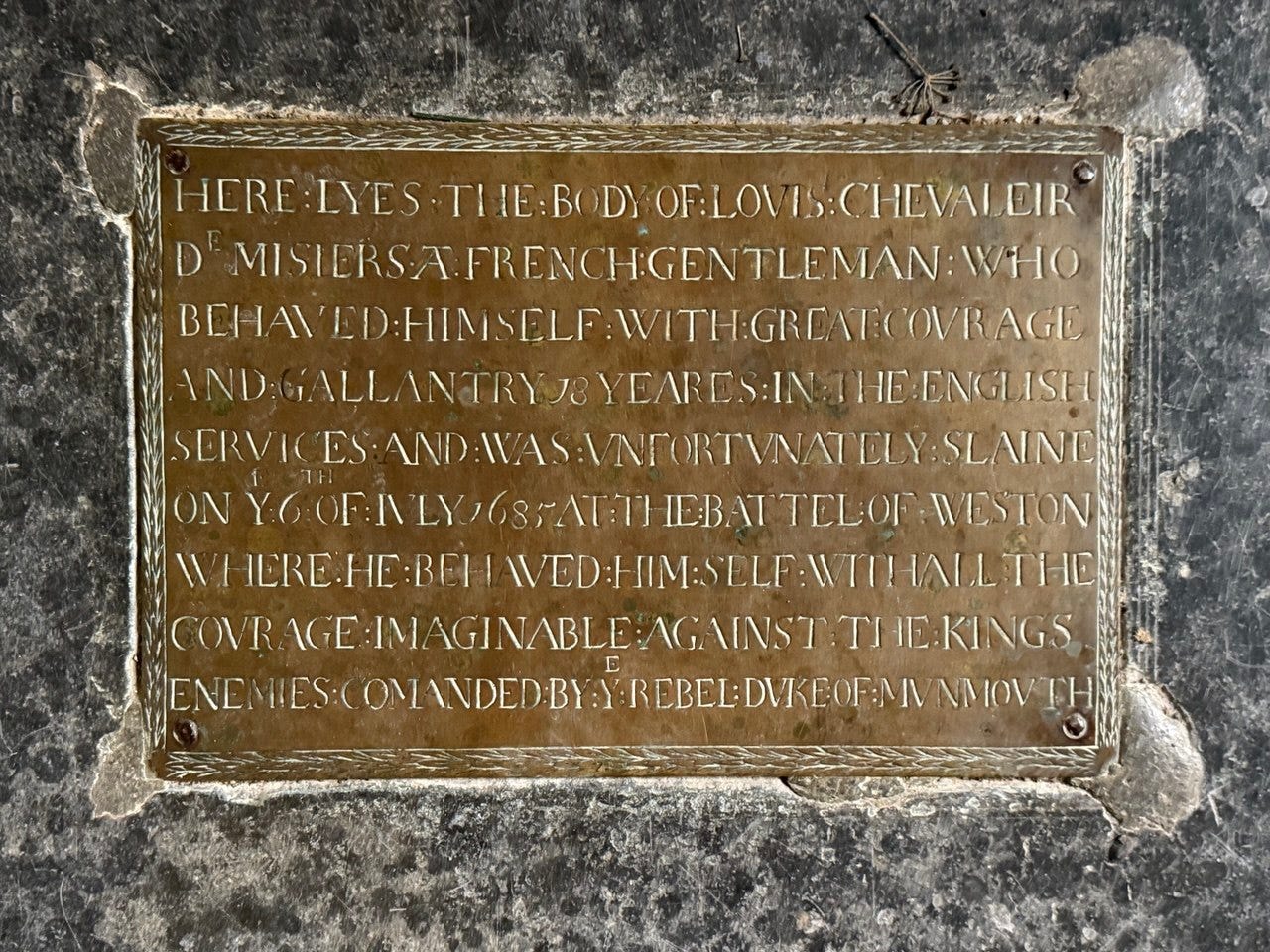
“HERE LYES THE BODY OF LOUIS CHEVALIER DE MISIERS A FRENCH GENTLEMAN BEHAVED HIMSELF WITH GREAT COURAGE AND GALLANTRY 18 YEARES IN THE ENGLISH SERVICE AND WAS UNFORTUNATELY SLAINE ON YE 6TH OF JULY 1685 AT BATTEL OF WESTON WHERE HE BEHAVED HIMSELF WITH ALL THE COURAGE IMAGINABLE AGAINST THE KINGS ENEMIES COMMANDED BY THE REBEL DUKE OF MONMOUTH.”
Feversham and James II were vindictive in victory. The Bloody Assizes under Judge Jeffreys saw hundreds executed, sold into slavery in the Caribbean, like the Covenanters before them, or flogged. His Assizes starting with 15 condemned in a makeshift court at the very same George Inn that had hosted Monmouth a fortnight earlier. One rebel, a Daniel Foe, escaped with a pardon and went on to become a spy for William the III, and with a little name jiggery pokery became the author Daniel Defoe.
Yet Churchill emerged with credit. He was promoted Major-General. His sympathies, though, were already clear. He had once remarked, with characteristic bluntness, “If the King should attempt to change our religion, I will instantly quit his service.” The Protestant cause ran deep in him.
And so, though Sedgemoor was the last full-scale battle on English soil, I shall write of that curious little skirmish in Kent another day, the story did not end. James’s Catholicism grew ever more blatant, his malice more open. A mere three years later, (less than between now and the General Election) in 1688, it was again in the South West that Protestant hopes revived. William of Orange landed at Brixham. Feversham still commanded the King’s forces; Churchill, now a general and an MP, remained outwardly loyal, until the moment came. Lord Cornbury’s defection threw Feversham into a fury; he demanded Churchill’s arrest. But Churchill had been quietly encouraging others to the Orangist cause. On 24 November he slipped away from the royal camp with four hundred officers and men, leaving a letter of cool justification:
“I hope the great advantage I enjoy under Your Majesty, which I own I would never expect in any other change of government, may reasonably convince Your Majesty and the world that I am actuated by a higher principle…”
It is said that the loss of Churchill, that loyal son of a Dorset squire, believer in England, stability, and the reformed Protestant faith, was the final straw. James fled the kingdom. The Glorious Revolution was accomplished almost without bloodshed.
Standing in those churchyards, watching the rooks wheel above the Levels, one cannot help musing on what Sedgemoor tells us today. The battle was lost. Its leaders were executed. The rebels’ cause seemed crushed. Yet within five years the very principles they fought for, liberty under law, Protestant security, limited monarchy – had triumphed. That settlement brought the Bank of England, the Bill of Rights, the growth of trade and empire. It led, in time, to the astonishing prosperity of the nation that would later be called, with justice, mirabilis, a miraculous flowering of stability and freedom. Defeat, it seems, is not always final. Sometimes the seed of victory lies in the furrow of apparent failure.
We live in anxious times ourselves. Old certainties erode; new orthodoxies press. Yet the story of these quiet churches on the Levels reminds us that history rarely moves in straight lines. Causes that seem lost can ripen in the soil of endurance. Liberty, once planted, proves hardy. And England, this stubborn, layered, miraculous land, has a way of righting herself, given time. I turned the car westward again, towards Wiveliscombe and its Baring built town hall, and thence towards the Cornish coast.
The Levels receded in the mirror, but their lesson travelled with me: look to past defeats, and look forward with hope. The great change may yet come.
This was a great read - I really enjoyed it. Also a welcome reminder of how quickly, and in unexpected ways, things can change. And not always for the worse.
I live in rural Somerset.
I love Somerset.
It's still proudly monocultural, and has its back turned away from London.
The Levels are extraordinary. Charles I for Dutch engineers in to make it farmable.
They did,
Still wobbly. You can walk along a lane, and if cows in a field by the road take off, you can feel the road gently wobble.